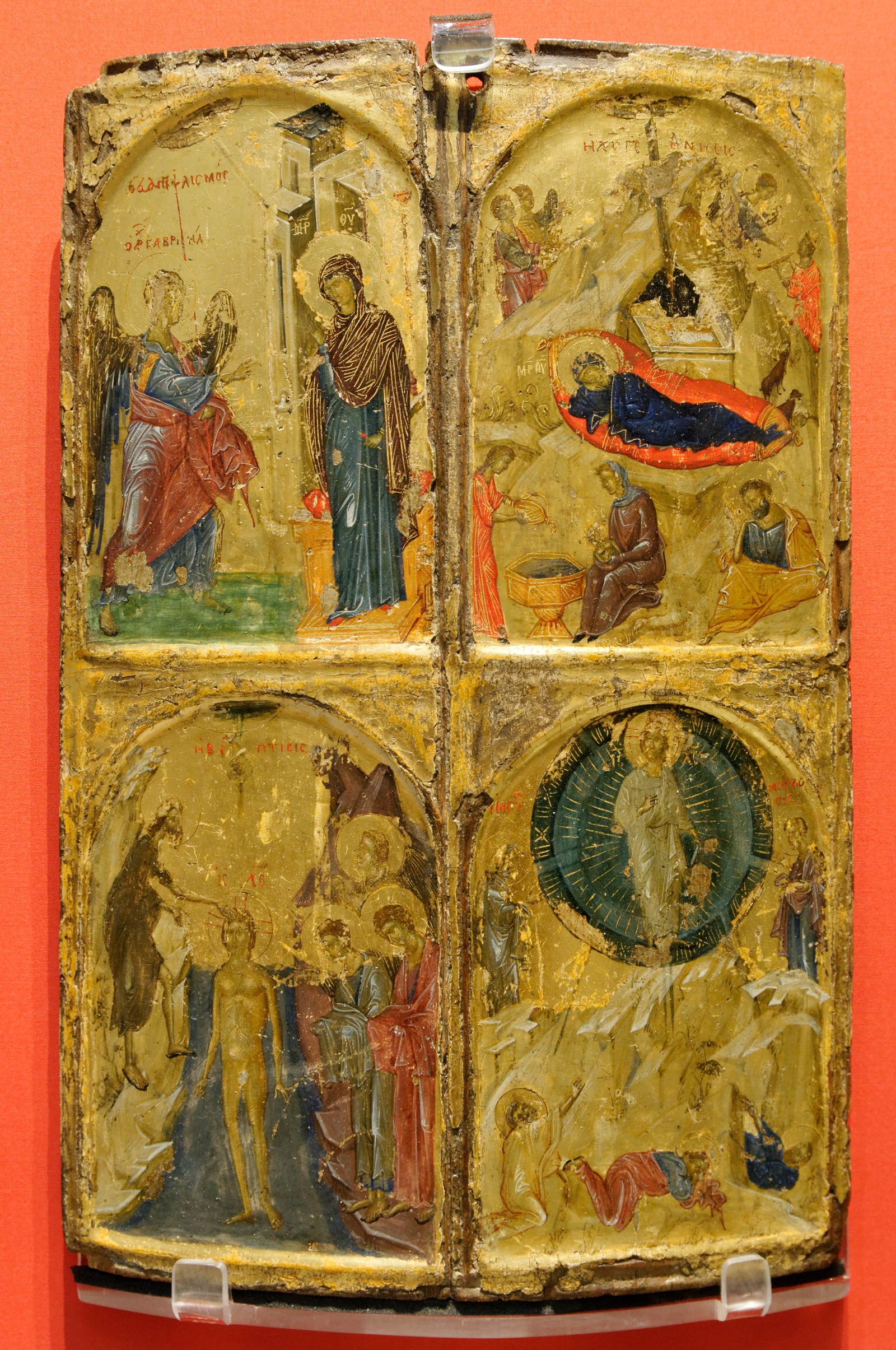
Four-Festival Icon (Annunciation, Nativity, Baptism, Transfiguration)
Tempera Panel Icon, c. 1310–1320, Thessaloniki — British Museum (BM 1852.1-02.1)
Doctrinal reflection
A single panel divided into four quadrants by a gilded cross-frame, each quadrant rendering a major Christological feast. Top left: the Annunciation (Gabriel approaching Mary; Holy Spirit dove descending). Top right: the Nativity (Theotokos reclining; Christ-child in manger; ox and ass; shepherds; magi). Bottom left: Christ's Baptism (Jordan; John the Baptist; Christ in the water; the Spirit dove). Bottom right: the Transfiguration (Mt Tabor; Christ in mandorla flanked by Moses and Elijah; Peter, James, John below). The icon is c. 1310–1320, Thessaloniki workshop, found in Egypt (St Mary Deipara monastery) before entering the British Museum in 1852. British Museum at 3/4.
The four-feast compositional strategy. Byzantine iconographic tradition organized the church-year around twelve major Despotic and Theotokic feasts (the Dodecaorton); abbreviated four-feast or six-feast variants survive in portable devotional panels for monastic and household use. The British Museum panel selects the four feasts that anchor the major moments of the Christ-as-incarnate-Lord doctrinal arc: Annunciation (incarnation begins), Nativity (incarnation visible), Baptism (incarnation enters public ministry), Transfiguration (incarnate divinity revealed in glory). The compositional theology: the four moments together render the incarnation accomplished — from conception through public glory.
The four-fold compositional restraint. The panel's four-quadrant structure refuses both narrative-strip (sequential story-telling) and single-monumental (one moment dominant) compositional strategies. The choice is parallel-typological — four quadrants reading as parallel-doctrinal-claims about the same Christ. The viewer's eye does not run sequentially through; the viewer reads all four at once and the doctrinal point lands as totality: this same Christ is conceived, born, baptized, transfigured. The compositional theology pattern-matches the corpus's Asymmetric-attention sub-pattern (locked at #74 Rossano blind man) but extended to four-fold: each quadrant renders Christ's initiating action in a different mode (sent → born → entering → revealing).
Thessaloniki origin and Coptic-Egyptian transmission. The icon was painted in Thessaloniki (Byzantine Empire's second city, the era's iconographic high-craft center after Constantinople) and somehow transmitted to a Coptic monastery in Egypt before its 19th-century purchase by the British Museum. The transmission route is undocumented but possible via late-Byzantine maritime trade, monastic exchange, or Crusade-era displacement. The corpus reads this transmission under the iconographic-survival principle (#70): late-Byzantine Greek iconography survived in Coptic-Christian monastic custody through the centuries of Mamluk and Ottoman rule that would have endangered Constantinople-region iconography directly.
Collection 5 framework — four feasts as Christological doctrine. Each feast carries doctrinal load: Annunciation (Luke 1:26–38; locked corpus reading at #annunciation-chora and #gabriel-annunciation-kurbinovo); Nativity (Luke 2 / Matt 2; locked at #nativity-daphni and #nativity-peribleptos-mistra); Baptism (Matt 3:13–17; the corpus has the Arian Baptistery #70 as the trinitarian-baptism iconographic anchor); Transfiguration (Matt 17:1–9; locked at #transfiguration-theophanes-greek and #transfiguration-sinai-apse). The four-festival panel pulls all four doctrinal threads into a single portable object — the incarnate Lord rendered four ways for daily devotional use.
British Museum 3rd entry — institutional broadening. The British Museum's Byzantine collection now at 3 entries: #triumph-of-orthodoxy-icon (Collection 10, c. 1400 Triumph of Orthodoxy panel) + #saint-george-british-museum (Collection 4 saints, c. 14th-c. Saint George panel) + this four-festival icon (Collection 5 Life of Christ). Lock A's three-entry-gap activates after this 2-from-non-consecutive-now-at-3 cluster. The British Museum may grow to 4/4 ceiling closure with a future entry; for now, 3/4 active.
Four quadrants. Four feasts. The same Christ is conceived, born, baptized, transfigured. The portable panel pulled the church year onto one wooden surface so the worshipper could remember the gospel arc daily. The Thessaloniki painter rendered the feasts; the Egyptian monks preserved the panel; the British Museum holds it now; the iconographic argument is the same — the Word was made flesh, and four moments of that flesh witness to the One.