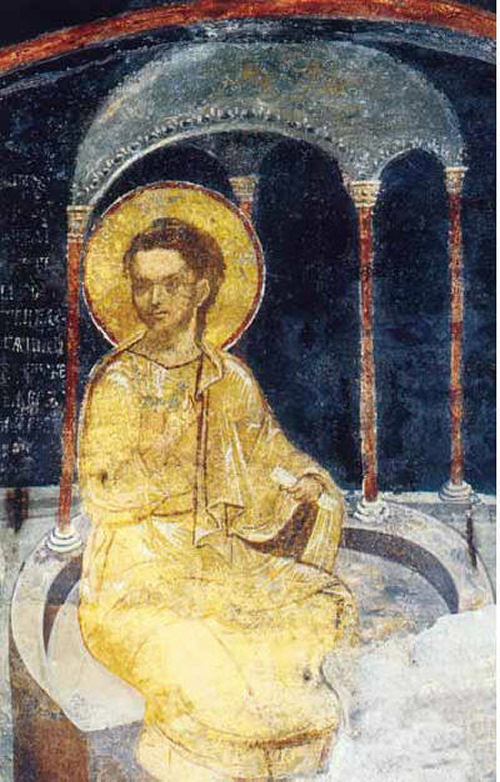
Christ among the Doctors (Young Jesus in the Temple)
Fresco, Boyana Church, Sofia, Bulgaria — 1259
Doctrinal reflection
A young figure sits at the center, smaller than the figures around him but rendered with the same iconographic dignity. Around him sit older bearded men in the dress of Jewish teachers — turbans, robes, scrolls in hand. The boy speaks; the elders listen. Above the central figure, a Greek inscription identifies him as ΧΡΙCΤΟC — Christ. The scene is Luke 2:41–52: the twelve-year-old Jesus at the Temple in Jerusalem, found by his parents three days after Passover "sitting in the midst of the doctors, both hearing them, and asking them questions". The fresco belongs to the 1259 Boyana program by the Boyana Master. The corpus's second Boyana entry alongside saint-nicholas-boyana (#95). Bulgaria broadens at Boyana to 2/4.
Luke 2:41–52 — the only canonical narrative of Christ's boyhood. The synoptic gospels are otherwise silent on Christ's life between infancy and adult ministry; the apocryphal infancy gospels filled the gap with extensive miraculous-childhood narratives (Christ slaying playmates, animating clay birds, etc.) that the canon refused. Luke 2 alone preserves a single boyhood narrative, and even Luke is restrained: "Wist ye not that I must be about my Father's business?" (2:49) — the Christ-confession is in his own mouth at twelve — and then "and Jesus increased in wisdom and stature, and in favour with God and man" (2:52). The Boyana iconographer renders only what the canon reports: the boy among the doctors, hearing and asking questions; no apocryphal embellishment.
Collection 5 register — Christ's true humanity anchored. The corpus has named the iconographic-restraint pattern at #58 Saint Christopher Cynocephalus (decline the legendary embroidery; render what the canonical witness preserves). The Boyana Christ-among-the-doctors operates by the same discipline. The doctrinal payload: Christ's true humanity required real human growth — physical (stature), intellectual (wisdom), social (favour with man) — and the early-church Christological controversies (Apollinarianism, Eutychianism) turned on whether Christ truly grew. The orthodox confession (Chalcedon 451) held that Christ has a real human nature with a real human mind that grew through experience. Luke 2:52 is the apostolic anchor; the Boyana fresco is the iconographic illustration. The boy at twelve hearing-and-asking is the same Person who at thirty-three would hang on the cross.
The compositional theology — child smaller, elders larger, eye-line inverted. The Boyana Master makes the boy iconographically smaller than the surrounding teachers (true to the narrative — he is twelve, they are adults), but the eye-line is inverted: the elders look down at the boy — and the elders hear the boy. The compositional reversal: physical scale says one thing (boy is smaller), eye-line says another (boy is teaching). The eye-line-as-doctrine principle (locked at #72 Climacus) operates here: Christ is teaching the teachers; the small figure at the center is the Word in flesh. His size deceives; his words instruct.
The Boyana Master's iconographic discipline. The Boyana Master (anonymous artist of the 1259 program) is one of the most-studied medieval Bulgarian painters; the iconographic clarity and emotional restraint of the Boyana program — over 240 figures across 89 scenes — is read by historians (Lazarev, Bakalova) as the high point of pre-Palaiologan Slavic iconography. The Christ-among-the-doctors fits the program's overall discipline: render what the gospel reports, avoid apocryphal embellishment, let the composition do the doctrinal work.
Bulgaria continues iconographic transmission. The Tarnovo school of medieval Bulgarian painting (1185–1396) was the iconographic bridge between the Constantinopolitan center and Slavic Eastern Europe. The Boyana program is its pre-Tarnovo flagship (in Sofia, before Tarnovo became the iconographic capital under the Second Bulgarian Empire's apex). The corpus's Bulgaria entries now span Saint Nicholas (#95, palimpsest-survival) and the Christ-among-the-doctors (this entry, Christological-anchor). Bulgaria's iconographic patrimony continues to render the apostolic line.
The boy at twelve sat among the doctors. He heard and asked. The doctors heard him. He went home with his parents and increased in wisdom. The Boyana Master painted what Luke wrote.