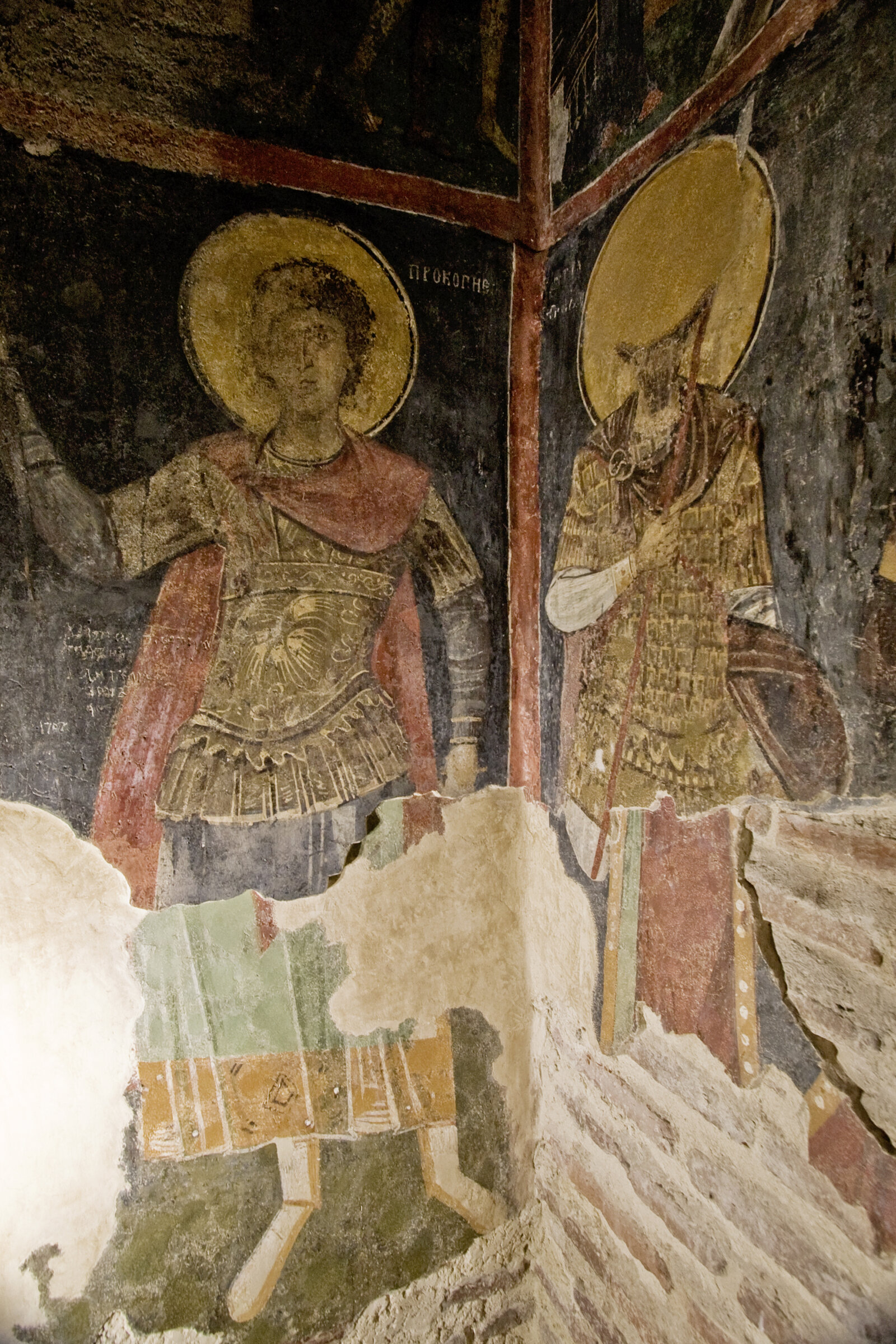
Saint Nicholas
Palimpsest Fresco, Boyana Church, Bulgaria — 11th-century underlayer + 1259 overpainting
Doctrinal reflection
Two Saint Nicholases occupy the same wall, one beneath the other.
The Boyana Church in Sofia, Bulgaria, contains a remarkable iconographic palimpsest: the 11th-century original layer of Nicholas's portrait is partially visible beneath the 1259 overpainting. The earlier figure shows the bishop in the older Byzantine vestment-vocabulary; the later overlays update the dress to reflect 13th-century Bulgarian liturgical practice. Both layers identify the same saint by the same iconographic markers — frontal bishop, white hair, close-cropped beard, gospel-book in left hand, blessing right hand — but the surface details have been reworked across two centuries of devotion. The corpus has its first Bulgarian entry, and Bulgaria opens with a literal demonstration of the iconographic-survival principle (#70).
Same Nicholas, two paintings. The corpus has already engaged Saint Nicholas at the 16th-century Cretan-school panel icon at the Walters Art Museum (#saint-nicholas-walters). The Walters entry handled the historically-defensible-core / decline-the-legendary-accretions Mode 4 framework that the Collection 7 named-decline rule supplies for canonized saints with substantial legendary embroidery. The Boyana entry does different work. Where the Walters icon presents Nicholas as iconographic figure, Boyana shows the iconographic process itself — how Nicholas was painted, repainted, and preserved across the centuries by communities that received him as a witness to Christ.
The iconographic-survival principle in palimpsest form. The 11th-century Boyana iconographer painted Nicholas in the vestment-vocabulary of the early-medieval Byzantine bishop. The 1259 iconographer (working under the patronage of sebastocrator Kaloyan and his wife Desislava) preserved the figure but updated the dress. What stayed: Nicholas's face, posture, gospel-book, blessing hand, episcopal identity. What changed: the surface details that registered cultural-liturgical period. The corpus has named this pattern at #70 Arian Baptistery — iconography that stays close to scripture survives the controversies its framers couldn't have foreseen. Boyana extends the move literally: iconography that stays close to apostolic-tradition recognition survives multiple paint layers, multiple political regimes, multiple liturgical revisions.
The corpus's named-decline rule applied silently. Boyana does not require the explicit we do not pray to Nicholas corrective the Walters entry made; the named-decline rule has been locked corpus-wide since #43 Sergius/Bacchus and the Walters entry has carried the negative construction for Nicholas specifically. What Boyana adds is the positive construction (15th-flagship cloud-of-witnesses pattern at #83 Rotunda): Nicholas is one named witness in the 11th-century Bulgarian church's wall and one named witness in the 1259 Bulgarian church's wall — same witness, different congregations, both pointing the worshipper to the One on whose altar the gospel-book was opened. They pray with us; we do not pray to them.
Bulgaria opens at 1. The Second Bulgarian Empire (1185–1396) was the political-historical context for the 1259 layer. Bulgarian medieval iconography sits between Byzantine imperial style and Slavic-vernacular adaptation; Boyana is one of the highest-quality surviving examples and a UNESCO World Heritage Site. The corpus has touched the broader Slavic register through Russian (Tretyakov), Macedonian (Nerezi), Serbian (Mileševa), and now Bulgarian iconography. Slavic Eastern Christianity was iconographically continuous with the Byzantine-Greek center; the regional inflections preserved doctrinal stability while updating cultural surface.
Scriptural Nicholas, beneath the legends. The historically-defensible Nicholas was bishop of Myra in Lycia in the early 4th century, traditionally a participant at Nicaea I (325) where the divinity of Christ was formally confessed in the creed. Of his actual writings, none survive. The legendary embroidery — the children-resurrection story, the gold for dowries, eventually the Santa Claus apparatus — accumulated across centuries. The corpus reads Nicholas as the bishop who confessed Christ at Nicaea, whose iconographic preservation in 11th-century and 13th-century Bulgaria testifies to the church's continuous reception of the orthodox faith across Slavic territory. We honor; we do not venerate. We follow Christ as Nicholas did.
Nicholas was painted at Boyana in the 11th century. He was repainted in 1259. He has not been painted out of the wall. The witness continues; the One witnessed to is the same.