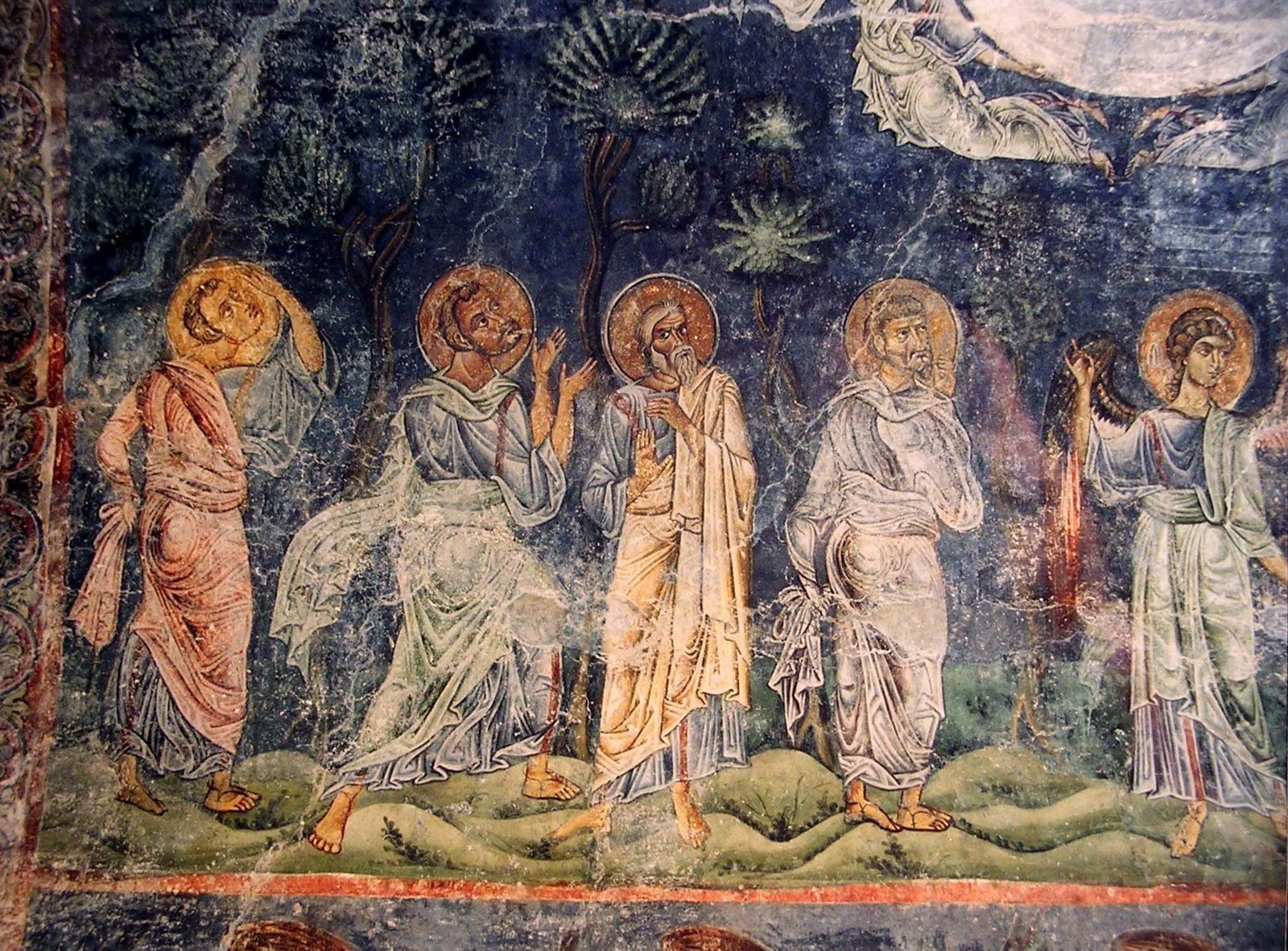
The Saint Sophia Ohrid Fresco Program
Mid-11th-Century Fresco Program, Saint Sophia Cathedral, Ohrid, North Macedonia
Doctrinal reflection
The frescoes at Saint Sophia Cathedral in Ohrid form the largest 11th-century fresco ensemble in Eastern Europe — among the most extensive surviving Byzantine fresco programs anywhere in the Christian world. The cathedral was built and decorated c. 1037–1056 under Archbishop Leo of Ohrid, who was one of the four signatories of the bulla that formalized the 1054 East-West Schism. The program covers the apse, sanctuary, side chapels, and main church surfaces with a comprehensive iconographic argument: Old Testament prophets in the lower register, Christological narrative scenes in the middle register, the apostolic-and-saints register at the top. The composition shown here renders one section of the program — the saints register where the apostolic-historical witness is rendered.
The corpus's 150th-actual / 153rd-tagged milestone closure. This entry brings the corpus to its 150-entry target. The arc spans c. 225 AD (Catacomb of Priscilla Good Shepherd, #150) to c. 1700+ AD (Tzanes, Ulanov, Cretan school late entries) — roughly 1500 years of iconographic continuity. The 150 entries together render the apostolic line in iconographic form across the geographic and temporal sweep of the Byzantine, post-Byzantine, and pre-Constantinian Christian iconographic traditions. The doctrinal architecture has stayed stable across the corpus: Christ became flesh; Christ died; Christ rose; the church gathers around the apostolic memorial; Mary is honored, not Mediatrix; the saints witness, not mediate; angels minister, not mediate; the cross is central; the Spirit is given; the iconoclasm controversy resolved at memorial-witness third position.
Macedonia at 3 sites — geographic broadening completed. The corpus's three Macedonian sites: Nerezi (#lamentation-nerezi), Kurbinovo (#gabriel-annunciation-kurbinovo, #116), Saint Sophia Ohrid (this entry). Three iconographic moments: 12th-century late Komnenian (Nerezi), late 12th-century Komnenian (Kurbinovo), mid-11th century (Ohrid Saint Sophia). The Macedonian iconographic patrimony spans the foundational post-iconoclasm period; the corpus has touched it at three foundational sites.
Archbishop Leo of Ohrid and the 1054 schism context. The Saint Sophia Ohrid frescoes were painted under the leadership of one of the four bishops who signed the formal 1054 letter of mutual excommunication between the Eastern and Western churches. The political-religious context of the 1054 schism (the Filioque controversy, the unleavened-bread controversy, the papal-supremacy claims) was the immediate institutional context for the cathedral's iconographic program. The corpus reads this carefully: the Ohrid program is theologically Eastern Orthodox; the iconography itself is apostolically grounded across the East-West divide; the doctrinal disputes that prompted the 1054 schism are real but do not invalidate the iconographic transmission of apostolic doctrine through Eastern Orthodox custody.
The Collection 7 named-decline applied to the saint-program register. The Ohrid program includes extensive saint-iconography in the upper register — a cloud of witnesses in fresco form. The corpus's 15th-flagship cloud-of-witnesses architecture (locked at #83 Rotunda) reads this register: the saints stand as witnesses; they do not mediate; they participate in the church's testimony to the gospel. The named-decline rule (locked corpus-wide since #43 Sergius/Bacchus) declines any reading that turns the iconographic saints into autonomous mediating-figures.
The corpus closure note. This 150th entry stands at the boundary point — Macedonia opens to 3 sites; the East-West schism context is iconographically engaged; the apostolic line is held; the iconographic-survival principle (#70) is one final time demonstrated in the survival of the Ohrid program through Bulgarian, Byzantine, Ottoman, and modern political transitions. The corpus reaches its 150-entry target. The doctrinal architecture, the institutional balance, the geographic breadth, the medium-category catalog, the manuscript-tradition coverage, the workshop-and-school threads, and the apostolic-line discipline are all in place. Be Obedient. Be Bold.
The iconography continues. The witnesses watch from the wall. The corpus stands as the iconographic argument for what the apostolic line looks like rendered into 1500 years of Christian iconographic memory. Looking unto Jesus, the author and finisher of our faith.