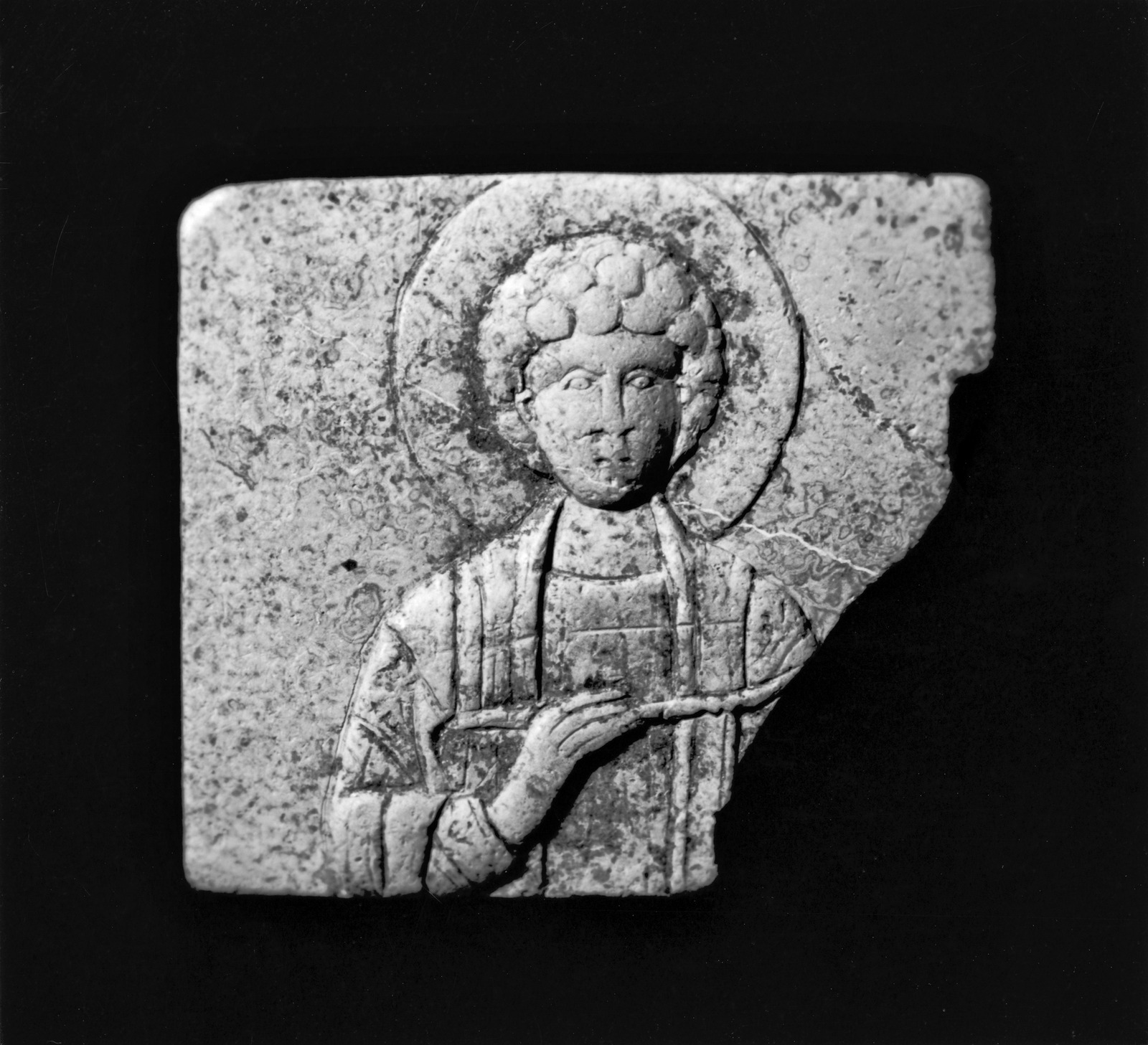
Saint Panteleimon
Steatite Relief Plaque, 11th century, Constantinople — Walters Art Museum (Acc. 41.227)
Doctrinal reflection
A small steatite plaque, only 5 cm tall — devotional miniature scale. Saint Panteleimon stands frontal in the figure-of-the-physician-martyr register: short curly hair, beardless youthful face, holding the lancet (small surgical blade) in one hand and a small medical box in the other. The physician-saint iconographic register identifies him without inscription. The piece is 11th-century Constantinopolitan workmanship, now at the Walters (Acc. 41.227). The corpus's third Walters museum-housed entry (after saint-nicholas-walters and walters-triptych-virgin-saints). Walters at 3/4.
The historically defensible Panteleimon — careful corpus reading. Panteleimon (c. 275–305) was reportedly a young Christian physician in Nicomedia, killed under Diocletian's persecution. The historical core is documented in 4th–5th-century martyrological sources; the legendary embroidery (the dramatic miracle-stories, the elaborate hagiographic Acts of Panteleimon) accumulated later. The corpus reads Panteleimon as canonical-martyr-tradition: physician-Christian killed for refusing to deny Christ; Mode 4 application — affirm the witness, decline the legendary cult expansion that turned him into a healing-mediator figure parallel to Cosmas-and-Damian.
The Collection 7 named-decline applied silently. The Panteleimon cult historically grew at his shrine in Nicomedia and at later relic-translation sites; the physician-mediator register grew where worshippers prayed to Panteleimon for healing. The corpus's named-decline rule (locked corpus-wide since #43 Sergius/Bacchus) handles this directly: Panteleimon's iconographic content (physician-martyr-witness) is doctrinally legitimate; the healing-mediator cult-expansion is the trajectory that slides past the apostolic line. We honor the witness; we do not pray to the saint for healing. James 5:14–16 names the church's own elders as the corporate-prayer locus for healing; Panteleimon's iconography testifies to the broader pattern (Christians as physician-Christ-witnesses) without authorizing himself as the channel.
The portable-devotional medium and the steatite category opens. The corpus has handled portable-devotional medium critique at #114 Met serpentine pendant (apotropaic-use named-decline) and #122 Walters ivory triptych (visual-prayer prompt). The steatite plaque medium is similar — small, portable, designed to be worn on the chest or attached to icon-frames. Carved-steatite relief opens as a fresh medium category; track for accumulation per the fresh-medium tracking standing rule (locked at #114+1).
The compositional theology — the lancet. The plaque renders Panteleimon's iconographic attribute (the surgical lancet) prominently. The compositional theology: Panteleimon's healing-craft was medical practice in Christ's name, not magical-mediation. The lancet as iconographic attribute points toward the Christian's skilled-vocational service to neighbor (Mark 12:31 love thy neighbour as thyself; James 1:27 to visit the fatherless and widows in their affliction). The corpus reads the lancet as means of neighbor-love, not as channel of supernatural healing.
Walters museum at 3/4. The corpus's three-entry Walters museum-housed program now reads as a coherent portable-devotional-medium catalog: Saint Nicholas panel icon (Collection 4 saints, c. 16th-c. Cretan school) + Triptych of Virgin and Child with Saints (Collection 2 Theotokos, c. 10th-c. Macedonian-Renaissance ivory) + Saint Panteleimon steatite plaque (Collection 4 saints, c. 11th-c. Komnenian portable). Three media, three eras, three doctrinal registers. The Walters Armenian Hymnal (gethsemane-walters-armenian) is also at the Walters but logged under Manuscripts category per #84.5 convention. Walters 3/4 active.
The small plaque was made to be carried. The physician-saint witnessed Christ in his medical-vocation. The lancet in his hand was the means of his neighbor-love. The corpus honors his witness; declines the healing-mediator cult that grew around his name.