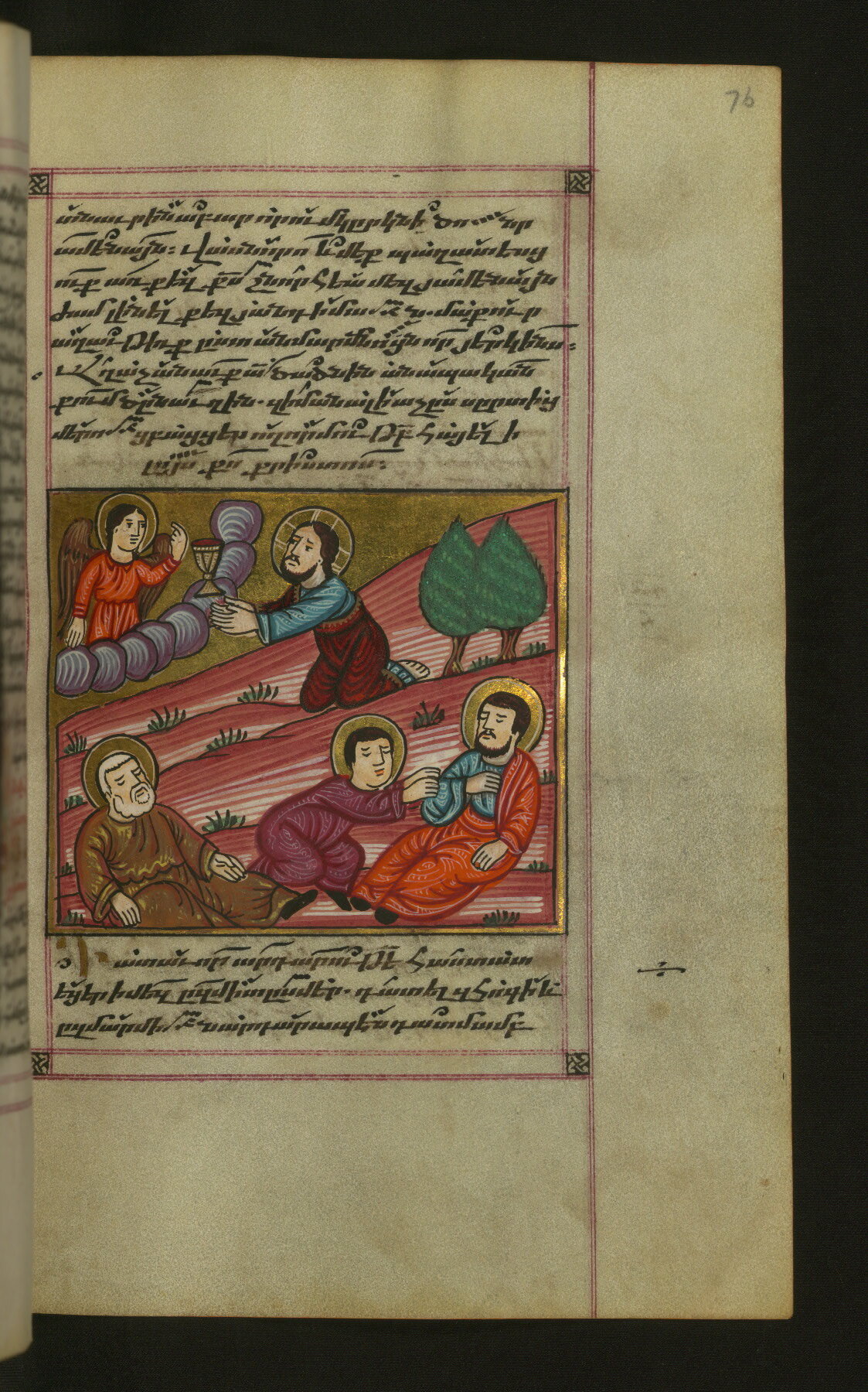
The Agony in the Garden
Armenian Hymnal, Walters MS W.547, fol. 76r — Constantinople, 1678
Doctrinal reflection
Christ kneels alone on a green slope of the Mount of Olives. Hands are raised slightly, palms open, head bent forward. To one side, the three disciples — Peter, James, John — sleep among the rocks, eyes closed, postures slack. Above and behind Christ, a small angel descends from a curling cloud-band, holding a chalice. The hymnal page surrounds the scene with an arched architectural frame, gold ground, and the marginal floral ornament of the Armenian-Constantinopolitan tradition.
The page is from the Hymnal (Šaraknoc') copied in Constantinople in 1678 by the priest Yakob Pēligratc'i — late post-Byzantine, Armenian iconographic vocabulary with Constantinopolitan ornament. The Gethsemane miniature sits at fol. 76r, where the hymnal's liturgical sequence reaches Holy Week. The composition follows the canonical Byzantine Gethsemane type: Christ at prayer, disciples sleeping, angel of the chalice.
"My soul is exceeding sorrowful, even unto death... Father, if it be possible, let this cup pass from me: nevertheless not as I will, but as thou wilt" (Matthew 26:38–39). Mark records the same prayer in similar words. Luke adds the angel: "And there appeared an angel unto him from heaven, strengthening him" (Luke 22:43). The Armenian iconographer's small chalice-bearing angel is Luke's angel rendered. The cup is the cup Christ asked the Father to remove.
Hebrews 5:7–9 carries the doctrinal weight. "Who in the days of his flesh, when he had offered up prayers and supplications with strong crying and tears unto him that was able to save him from death, and was heard in that he feared; though he were a Son, yet learned he obedience by the things which he suffered." The iconography is strong crying and tears in compositional form. The kneeling posture, the bent head, the open hands — these are the visual register of supplication, not of stoic acceptance. The Lord did not arrive at Gethsemane already past the human cost of what he was about to do. He prayed. He sweated. He asked. He consented.
This is the iconography of consenting obedience, not of divine impassibility. Christ does not will the cup easily. He wills it truly — through the prayer, not around it. The Father's yes to him in the resurrection is hidden inside the Father's apparent no in the garden. Though he were a Son, yet learned he obedience.
The sleeping disciples are the iconography's contrary witness. Christ asked them to watch with me (Matt 26:38). They could not. The corpus has met this contrast before — the disciples' instinct in the moment of crisis is the wrong one (Peter's sword at the Betrayal, #86 Karanlık) — and Gethsemane is the same lesson in advance. The spirit indeed is willing, but the flesh is weak (Matt 26:41). The fresco's sleeping disciples are not painted with contempt; they are painted with the gospel's own register of pastoral patience. Christ does not strike them. He returns and asks again.
The cup is named. Christ's let this cup pass is real. The cup is the cup of wrath the OT prophets warned of (Isaiah 51:17, Jeremiah 25:15) — drained in mercy by the one who did not deserve it. The chalice-bearing angel visualizes what Christ accepted. The cup of wrath received by Christ becomes the cup of communion shared with the church (1 Cor 11:25). Same cup, transformed by what Christ did with it.
When we preach Gethsemane, do not collapse the prayer into the cross. The prayer is its own work. The Lord prayed with strong crying and tears and learned obedience through the prayer itself. Our own prayers in the dark hours pattern-match here. Let this cup pass is permitted. Not as I will, but as thou wilt is required. Both clauses are the same prayer.
He prayed. The disciples slept. He went anyway.