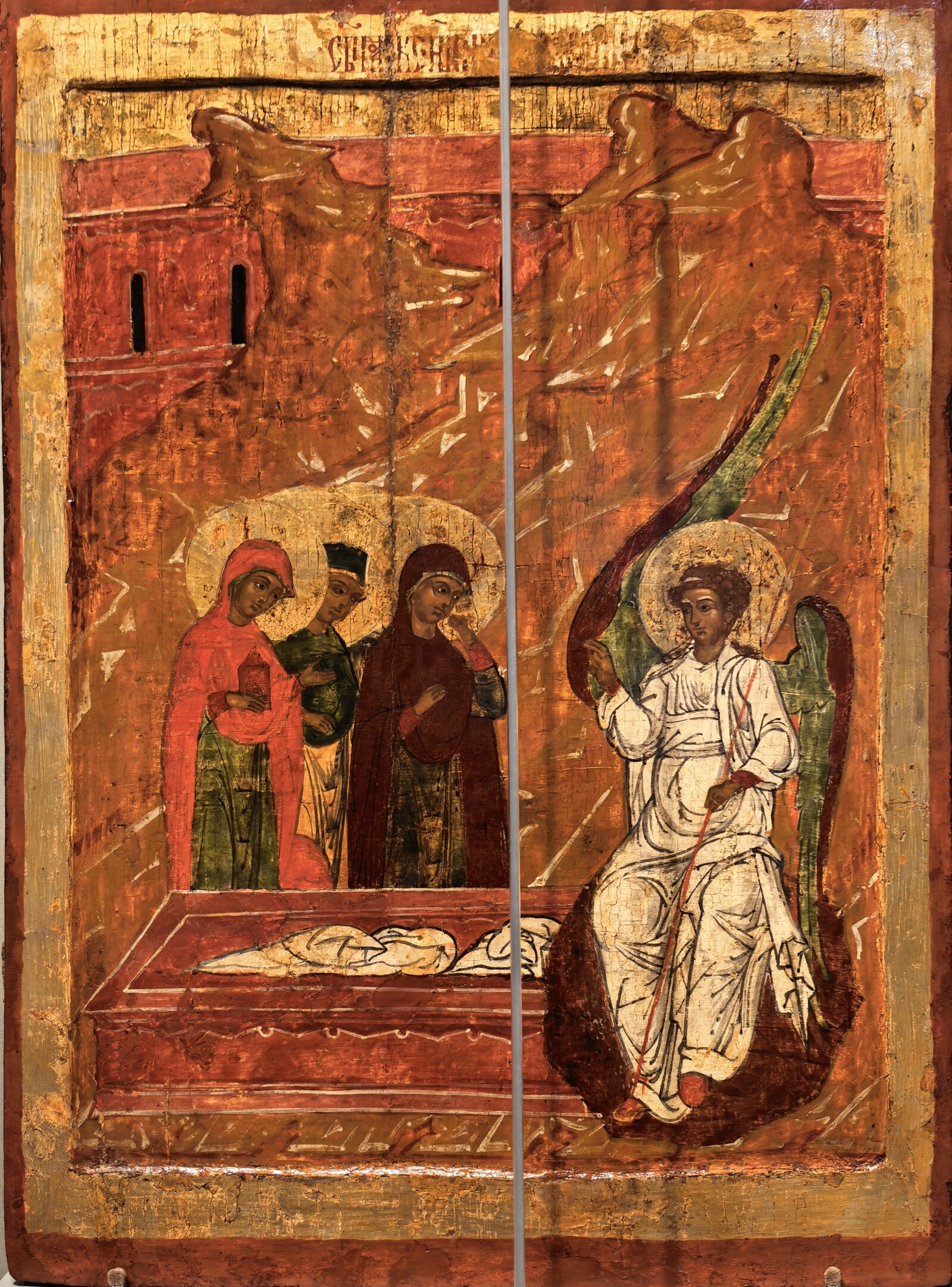
The Myrrh-Bearing Women at the Tomb
Russian Icon, Arkhangelsk Region, 17th century — State Hermitage Museum, St Petersburg
Doctrinal reflection
Three women approach the tomb in single file, vessels of myrrh and aloes in their hands. The stone is rolled away. Inside the tomb, an angel sits on the ledge where Christ's body had been laid; the grave-clothes lie folded at his feet. Above the angel, in the upper register of the icon, the risen Christ stands gesturing to the women — a second moment, a few minutes later, the chairete of Matthew 28:9. The icon compresses the morning of the resurrection from John's chapter twenty into a single panel: the journey, the discovery, the encounter. It is a 17th-century Russian icon from the Arkhangelsk region of the Russian North, now at the State Hermitage in St Petersburg, painted in the continuous post-Byzantine iconographic vocabulary that Russian Orthodox communities had received from Constantinople and Kyiv across seven centuries.
The scene combines material from all four gospels (Matt 28:1–10; Mark 16:1–8; Luke 24:1–10; John 20:1–18). The named women vary across the accounts — Mary Magdalene appears in all four; Mary the mother of James, Joanna, Salome, and the other Mary appear in different combinations. The Eastern Orthodox tradition harmonizes them as the Myrophoroi (μυροφόροι) — the myrrh-bearers — and commemorates them on the second Sunday after Easter.
The first witnesses of the resurrection were women. Mark's gospel, the earliest written, names this explicitly: the angel tells the women "go your way, tell his disciples and Peter that he goeth before you into Galilee" (Mark 16:7). Matthew records Christ himself stopping the women on the way and giving them the same charge: "All hail. Be not afraid: go tell my brethren" (Matt 28:9–10). The first apostolic-commissioning words of the resurrected Christ in Matthew's gospel are spoken to Mary Magdalene and the other Mary, not to the Eleven. The Eleven receive the news from the women.
Apostolic-baseline implications. The corpus has named the apostolic-baseline argument at #90 Tsalenjikha Doubting Thomas — Thomas's My Lord and my God as the highest Christological confession in the gospels, the model of direct apostolic witness. The Myrrh-bearers episode is an earlier stratum of the same baseline. Mary Magdalene was the first witness to the empty tomb, the first to speak with the risen Christ, the first commissioned to tell the apostles. The traditional designation isapostolos — equal to the apostles — applied to Mary Magdalene by the Eastern church preserves what the gospels themselves witness: her testimony was the apostles' first source.
This is doctrinally consequential against any framework that requires apostolic-witness-by-touch or apostolic-witness-by-male-line for the gospel's transmission. The first link in the resurrection-witness chain was a woman who had not yet seen Peter or John when she met the risen Christ. The chain begins with her, and Peter receives it from her testimony.
The angel at the tomb. The icon's angelic figure pattern-matches against #91 Mileševa White Angel: ministering not mediating, announcing what has already occurred, pointing rather than performing. The corpus's Collection 8 framing rule (Heb 1:14) is silently active. The resurrection is Christ's act; the angel reports.
Hermitage opens to 3. The corpus has had two prior Hermitage entries — two-theodores-hermitage (Collection 7) and forty-martyrs-sebaste (Collection 7) — both saint-martyr panels. The Myrrh-bearers icon adds a Christological-narrative panel from the Russian post-Byzantine tradition. The Hermitage's Russian Orthodox icon collection holds substantial 16th–18th-c. material in continuous Byzantine iconographic tradition.
The women came to anoint the body. They found an angel and a folded grave-cloth. Christ met them on the way and said go tell my brethren. The first apostolic commission was given to Mary Magdalene.