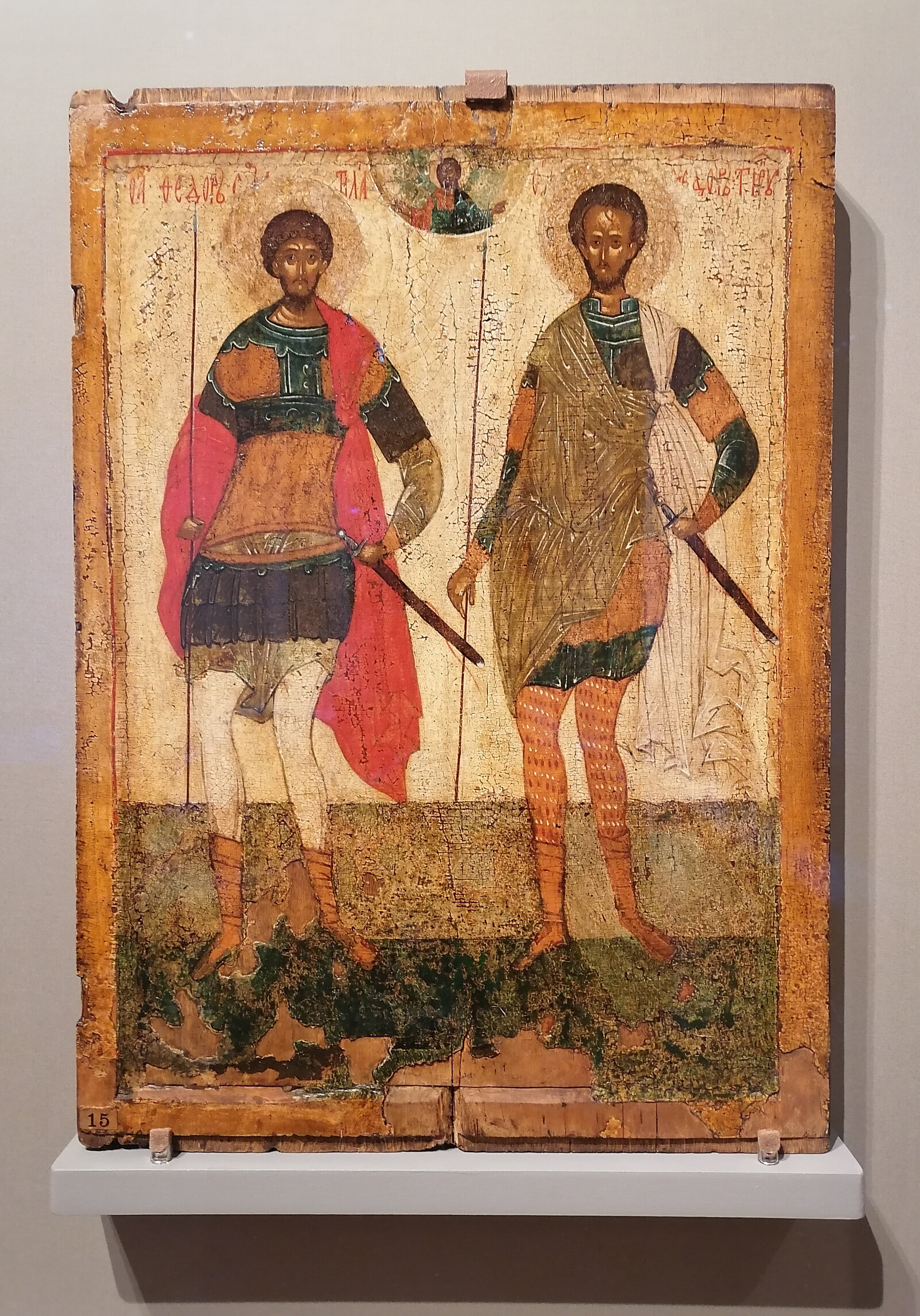
Saints Theodore Stratelates and Theodore Tyron
15th-century Russian Icon (Byzantine Tradition) — State Hermitage Museum
Doctrinal reflection
Two soldiers, one name, paired in a single icon.
This 15th-century Russian icon, in the Hermitage in Saint Petersburg, shows Saints Theodore Stratelates and Theodore Tyron standing side by side in military attire. Stratelates means "general"; Tyron means "recruit." The Byzantine tradition kept the two Theodores distinct — Theodore Tyron, a 4th-century Roman recruit-martyr from Amasea in Pontus, and Theodore Stratelates, a 4th-century Roman general-martyr from Heraclea. Both were executed under Licinius for refusing to perform pagan sacrifices. By the late Middle Ages they were almost always painted together — soldier-saint pair, like Sergius and Bacchus, like Cosmas and Damian.
The historical core for both Theodores is similar to George's: real soldier-martyrs of the Diocletianic and Licinian persecutions, executed for refusing the imperial pagan cult. As with George, the legends grew large over centuries — Theodore Tyron is said to have burned a pagan temple of Cybele in Amasea before being executed; Theodore Stratelates is said to have destroyed pagan idols in Heraclea, been crucified, miraculously preserved, then beheaded. The dramatic flourishes are likely later embellishments. The historical core — they refused the cult and were killed for it — is sufficient.
The iconography of the two Theodores is interesting because it shows the plural shape of Christian witness. They are painted together because martyrdom is rarely solitary in the early church. Stephen had a crowd of stoners but his witness was alone; the Forty Martyrs were forty; Sergius and Bacchus were two; the Theodores became iconographically two. The pattern: the witness of one saint is augmented by the witness of another. "They overcame him by the blood of the Lamb, and by the word of their testimony" (Revelation 12:11). The plural pronoun in Greek is autoi — they overcame, not he overcame. The army of testifiers is plural.
We do not pray to the Theodores. We do not invoke them as patrons of soldiers, of civic protection, or of any other category that the Byzantine cult assigned them. The mediation belongs to Christ alone (1 Timothy 2:5). We honor them as Hebrews 11–12 honors faith-witnesses: as men who finished their race ahead of us.
Note one detail in the Russian iconography. Both saints carry weapons. The Byzantine tradition depicted soldier-martyrs with their armor and arms intact — a deliberate choice. The point is not that swords saved them; the point is that even men trained for violence were called to refuse the violence the empire demanded. They were soldiers who would not soldier for idols. Their weapons in the icon are symbolic of their training; their martyrdom is the witness that their training served Christ rather than Caesar.
When you preach the Theodores, do not preach them as battle-saints. Preach the refusal. The Christian who is trained for combat may still be required to refuse a particular fight. The Theodores' weapons are in their hands; the choice they made was to lay down the life the weapons trained them to defend.
Lay it down for Christ.