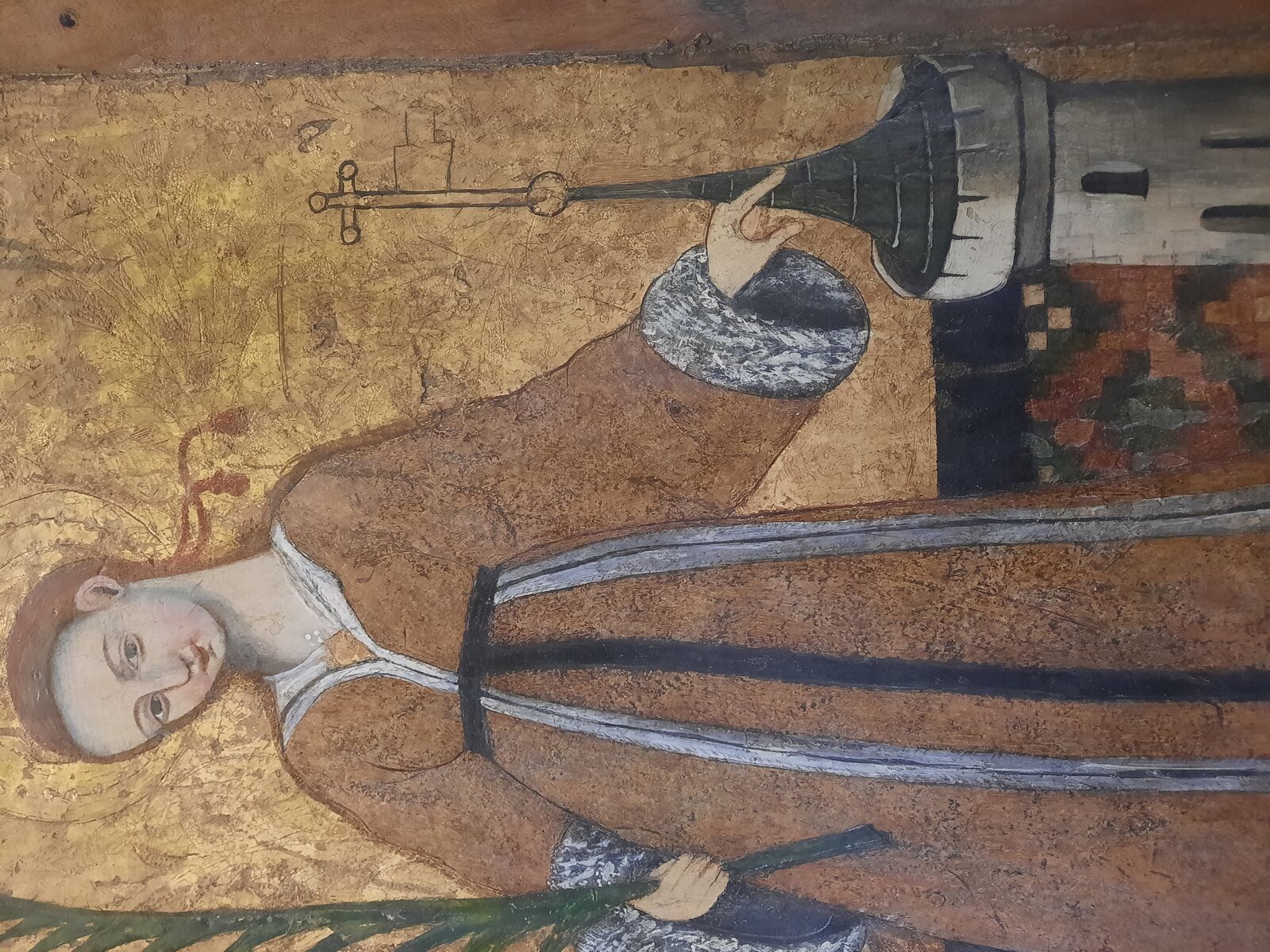
Saint Barbara
15th-century Coptic Icon — Coptic Museum, Cairo
Doctrinal reflection
Barbara stands frontal, crowned, holding a small architectural model — the tower with three windows — in her left hand and a martyr's cross in her right. The icon is from the Coptic Museum's panel-icon collection, painted in the 15th century in the continuous Coptic iconographic tradition that survived through Mamluk-period Egypt under conditions of formal Islamic political rule and informal Christian community persistence. The Coptic Church preserved its iconographic vocabulary across the medieval centuries with remarkable continuity; Barbara's tower iconography here matches the type rendered in Constantinople, Greece, and Russia during the same period.
The historically-defensible Barbara. Tradition places Barbara in 4th-century Heliopolis (or, in some traditions, Nicomedia), a young woman whose pagan father imprisoned her in a tower to keep her from suitors. She converted to Christianity in the tower, broke the second-window arrangement her father had ordered to make a third window symbolizing the Trinity, was tortured by her father, and was executed by him with a sword (after which the father, by pious tradition, was struck dead by lightning on his way home). Her actual existence is poorly attested in early Christian sources; the Roman martyrology removed her from the universal calendar in 1969 because her historicity could not be confirmed by independent record.
The corpus's standard pattern for canonized saints with substantial legendary embroidery (locked at Collection 7's Mode 4 framework — #51 Christopher, #48 George, #47 Nicholas) applies directly. Affirm the historically-defensible core (a young female martyr from late-Roman Egypt or Asia Minor, executed for refusing to renounce her Christian faith, whose memory the early church preserved); decline the legendary embellishments (the lightning-struck father, the three-window symbolism elaborated into elaborate Trinitarian iconography, the patronage-of-artillerymen apparatus that grew in medieval Europe); decline veneration (the corpus does not pray to Barbara, does not invoke her as patroness of any guild or military branch, does not offer petitionary mediation through her).
What the corpus keeps: a young woman who chose Christ over her father's authority and paid for the choice with her life. That story is the corpus's affirmable doctrinal payload — the cost of discipleship can be one's own family (Matt 10:34–37: "He that loveth father or mother more than me is not worthy of me"; Luke 14:26–27). The historical reality of Barbara as a name behind that pattern is uncertain; the pattern itself is thoroughly biblical.
The tower as iconographic reading. Barbara's tower is not merely a biographical detail but a doctrinal signal. The third window — broken into the architecture so the prison-tower could become a Trinity-confessional space — is the iconographer's argument that confession is possible under any conditions, including imprisonment by hostile family. The tower walls cannot prevent the third window. Stephen confessed under stones (Acts 7); Paul confessed in the Roman jail (Acts 16); Barbara confessed in the family tower. Confession is not bound by location or political-judicial conditions.
Coptic-tradition continuity. This is the corpus's third Coptic Museum entry (#christ-mandorla-bawit-coptic at #84, #michael-weighing-souls under workshop/school but archived at the Coptic Museum, plus this Saint Barbara at #103). The Coptic Church has preserved continuous iconographic tradition through pharaonic-Roman-Byzantine-Arab-Ottoman-modern political transitions; the iconographic survival pattern (locked at #70 Arian Baptistery) operates across the longest unbroken political-tradition span of any Christian community. What the iconography depicts has survived because what the iconography depicts is anchored in the apostolic gospel rather than in any single political-cultural context.
Egypt opens to 2 distinct entries. Bawit (#84) is the early-Coptic anchor; Saint Barbara is the late-medieval-Coptic addition. Together they bracket Coptic iconographic continuity across roughly nine centuries (6th–15th).
Barbara confessed. The tower had three windows. The corpus reads what scripture allows and stops where the legend takes over.