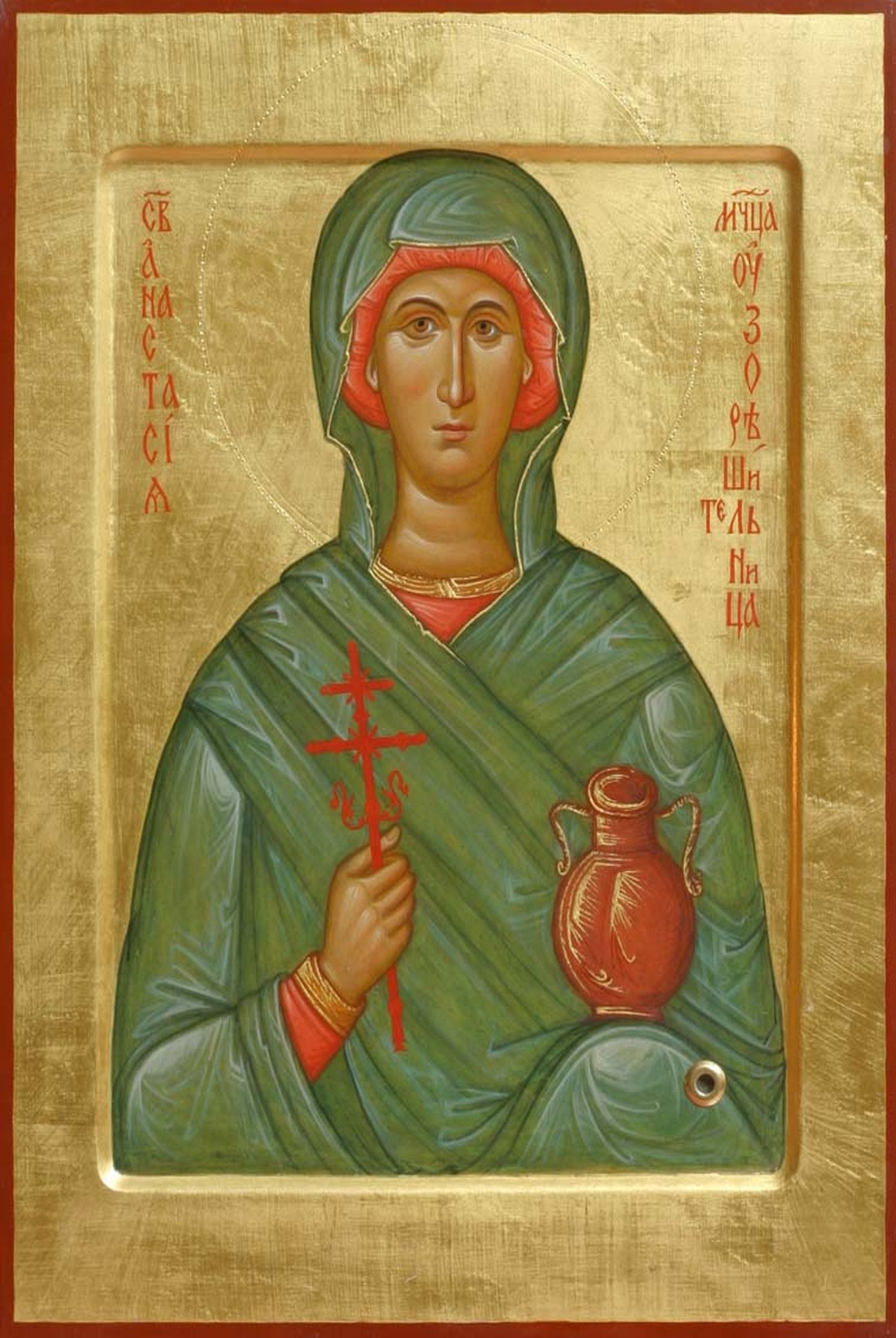
Saint Anastasia of Sirmium
Panel Icon, late 14th century, Constantinople — State Hermitage Museum, St Petersburg
Doctrinal reflection
A young woman stands frontal, robed in dark martyr's mantle over a red tunic, holding a small flask in her left hand and a martyr's cross in her right. Greek inscription identifies her: Η ΑΓΙΑ ΑΝΑCΤΑCΙΑ — the Holy Anastasia. The flask is her iconographic attribute — Anastasia of Sirmium (d. c. 304) was venerated as a Pharmakolytria (φαρμακολύτρια — deliverer from poisons), and the flask refers to the medicines/healing-oil tradition that grew at her shrine. The icon is c. 1370–1400, late Palaiologan Constantinople, now at the Hermitage. The corpus's third Hermitage entry (Hermitage 3/4).
The historically defensible Anastasia. Anastasia was a Roman noblewoman from Sirmium (modern Sremska Mitrovica, Serbia) martyred under Diocletian's persecution c. 304. The earliest hagiographic notice is in the 5th-century Martyrologium Hieronymianum; her cult spread to Constantinople where the Anastasia Church became a major site, and her relics were translated to the imperial capital. The corpus reads her as canonical-martyr-tradition: the historical core (Sirmium-origin Christian noblewoman martyred under Diocletian) is well-attested; the legendary embroidery (the elaborate hagiographies of the Acts of Anastasia, the medical-miracle tradition) accumulated later.
Mode 4 application — Collection 7 named-decline. Anastasia's Pharmakolytria (poison-deliverer) cult is exactly the trajectory the corpus's Collection 7 named-decline addresses: the saint-as-witness slides toward saint-as-channel-of-protection. The flask in Anastasia's hand carries iconographic ambiguity — historically it pointed to her ministry to imprisoned Christians (she brought medicine and food to confessors before their executions); in late-medieval cult, it pointed to her as healing-mediator. The corpus reads the historical core (her diaconal-care ministry to suffering Christians) and declines the cult expansion (her as direct medical-mediator). We honor her ministry; we do not pray to her for healing.
Collection 4 framework — 15th-flagship cloud-of-witnesses pattern-match. Anastasia stands in the cloud of witnesses (Heb 12:1, locked at #83 Rotunda) — one named martyr among the host of the testifying dead. The corpus's locked Collection 4 reading: the saint witnesses; the saint does not mediate. Anastasia's iconography reads cleanly when the flask is read as ministry-tool (her diaconal kit, the medicines she carried to imprisoned Christians) rather than as cult-attribute (her as healing-channel). The iconographer's compositional restraint — frontal pose, simple gesture, modest cross — keeps the iconography on the apostolic line.
The female-martyr register. The corpus's existing female-saint entries (Saint Barbara at #103, Theotokos entries throughout, Saint Catherine considered at the Athens museum) cluster the iconographic-witness of women in the early-Christian persecution. Anastasia joins this register at the late-Palaiologan moment. The compositional confidence of the late-14th-century painter — the modeling of the face, the texture of the mantle — registers the iconographic peak before the empire's 1453 collapse.
The Hermitage's late-Byzantine icon collection. The Hermitage acquired a substantial body of late-Byzantine and post-Byzantine iconography through the Russian Archaeological Institute in Constantinople (founded 1894, dissolved 1914). The Anastasia icon belonged to that Institute's Constantinopolitan collection before being moved to St Petersburg. The Iconographic-survival principle (#70) operates at the institutional level: the Russian Imperial scholarly apparatus preserved Constantinople-origin iconography that would otherwise have been lost to the Ottoman period or the post-1922 Turkish secularizing transitions.
Anastasia stood at Sirmium under Diocletian. She brought medicine to the imprisoned. She was killed for her witness to Christ. The flask in her hand testifies to her ministry; the cross in her hand testifies to her death; the icon at the Hermitage testifies to the church's continuous memorial of her witness. They watch with us; we do not pray to them.