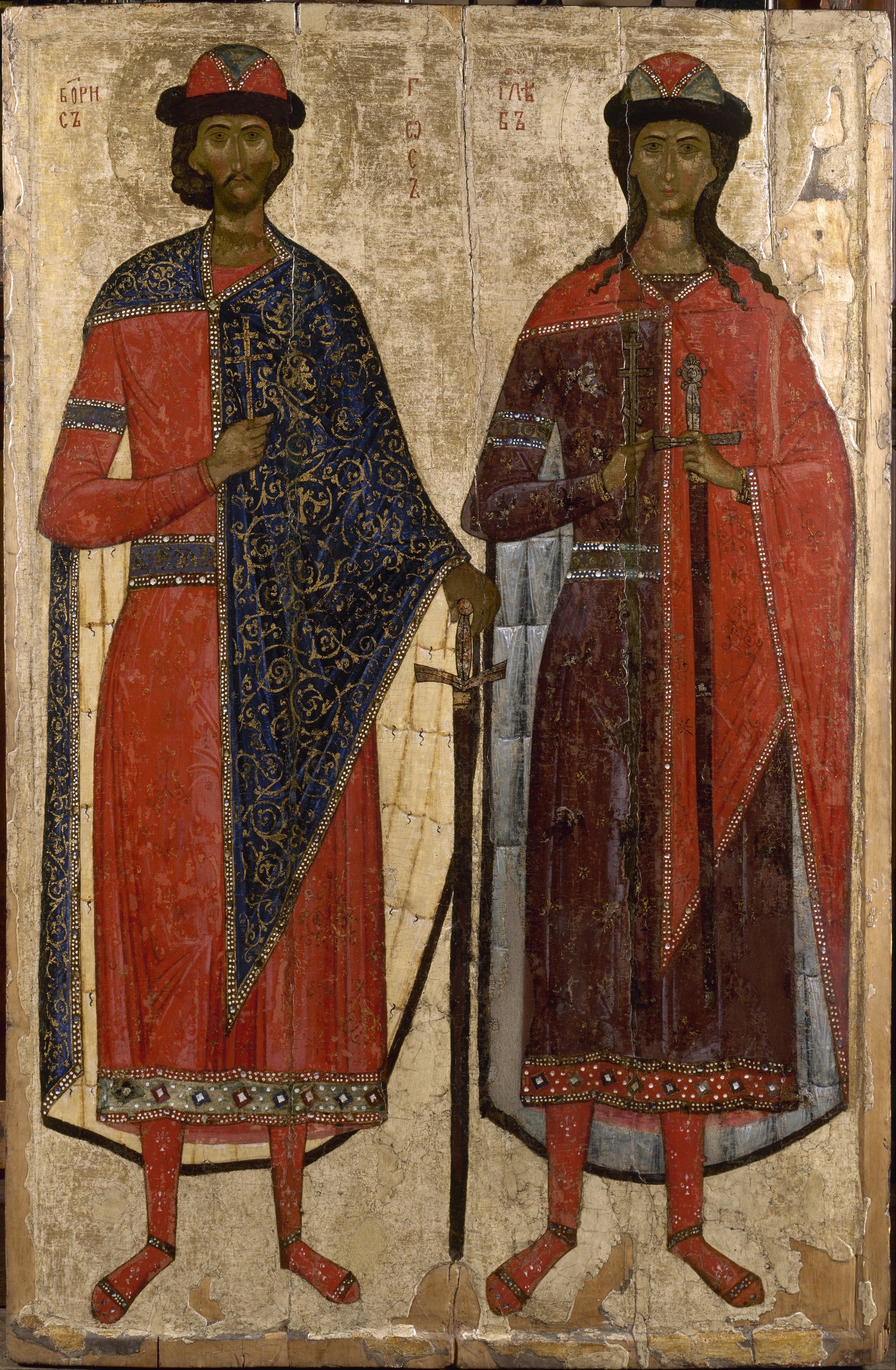
Saints Boris and Gleb
Panel Icon, mid-14th century — State Russian Museum, St Petersburg
Doctrinal reflection
Two young princes stand frontal, side by side. Both wear royal robes — gold-bordered cloaks over patterned tunics, fur-trimmed hats. Each holds a martyr's cross in the right hand and a sword (sheathed) in the left. Their faces are similar — they were brothers — but distinct: Boris bearded, Gleb beardless. Names in Cyrillic above their haloes. The icon is c. 1340–1370, Old Russian iconographic flowering, now in the State Russian Museum, St Petersburg — the corpus's second Russian Museum entry alongside the Novgorod Anastasis (#111). Tempera on wood, 94.3 × 142.5 cm. Russian Museum 2/4.
The 1015 martyrdom. Boris and Gleb were sons of Vladimir the Great (c. 958–1015), the Kievan-Rus prince who Christianized his realm in 988. When Vladimir died in 1015, the eldest brother Sviatopolk (later called the Accursed) seized the throne and ordered his half-brothers killed. Boris received warning and was advised by his retinue to march on Kiev and take the throne by force. He refused — "How can I lift my hand against my elder brother? If he is to be my father in place of our father, then let his will be done with me." Boris was killed at the Alta River. Gleb was killed shortly after at the Smyadyn River near Smolensk. Both went to their deaths refusing to fight back.
The non-resistance register. The chronicle accounts (the Tale of Boris and Gleb and the Primary Chronicle) frame the brothers' deaths as direct obedience to Christ's teaching: "Ye have heard that it hath been said, An eye for an eye, and a tooth for a tooth: But I say unto you, That ye resist not evil... Love your enemies, bless them that curse you, do good to them that hate you, and pray for them which despitefully use you, and persecute you" (Matt 5:38–44). Boris's refusal to march on Kiev is the chronicle's deliberate echo of Matthew 5. The Russian church canonized them in 1071/1072 under Yaroslav the Wise — the first canonized Russian saints. The category created for them in Slavic Orthodoxy was страстотерпцы (strastoterptsy — passion-bearers): saints who suffered violence in conformity to Christ rather than for direct confession of faith.
Collection 4 framework, 15th flagship pattern-match. The Heb 12:1 cloud-of-witnesses lock (#83 Rotunda) holds: saints stand as witnesses, not mediators. Boris and Gleb's iconography renders them in visual catechesis — what does Matthew 5 obedience look like in flesh? Two young princes refusing to take up arms even when their lives depend on it. The witness is not the mediation; the witness is the testimony that Christ's teaching can be lived in real history. The icon shows them holding both cross and sword — the cross they took up; the sword they laid down.
The first Russian saints. Their canonization is theologically significant beyond the specific case. The gospel's universality reaches into every people-group; the witnesses of Christ multiply in every land. The 1015 martyrdom and the 1071 canonization are the iconographic-historical proof that the gospel had become Russian — not merely a Greek-Byzantine import imposed by Vladimir's 988 conversion, but a faith whose first martyrs were Russian flesh laid down for Russian gospel-obedience. The corpus reads this as the Acts 1:8 trajectory continuing — witnesses unto me... unto the uttermost part of the earth — reaching the Slavic north.
The corpus's restraint at Russian-saints territory. The corpus reads Boris and Gleb as canonical NT-pattern saints, witnesses to Matt 5 obedience, in the memorial-witness register. The corpus declines any reading that would make them autonomous Russian-political-religious symbols, mediators of grace, or icons of national sanctity disconnected from the Matthew 5 ground. Their flesh testifies to Christ's teaching; the testimony is the witness; the witness is not the mediation.
Boris refused. Gleb refused. They did not lift the sword. The cross alone in the right hand is the gospel; the sword sheathed in the left is what they did not use.