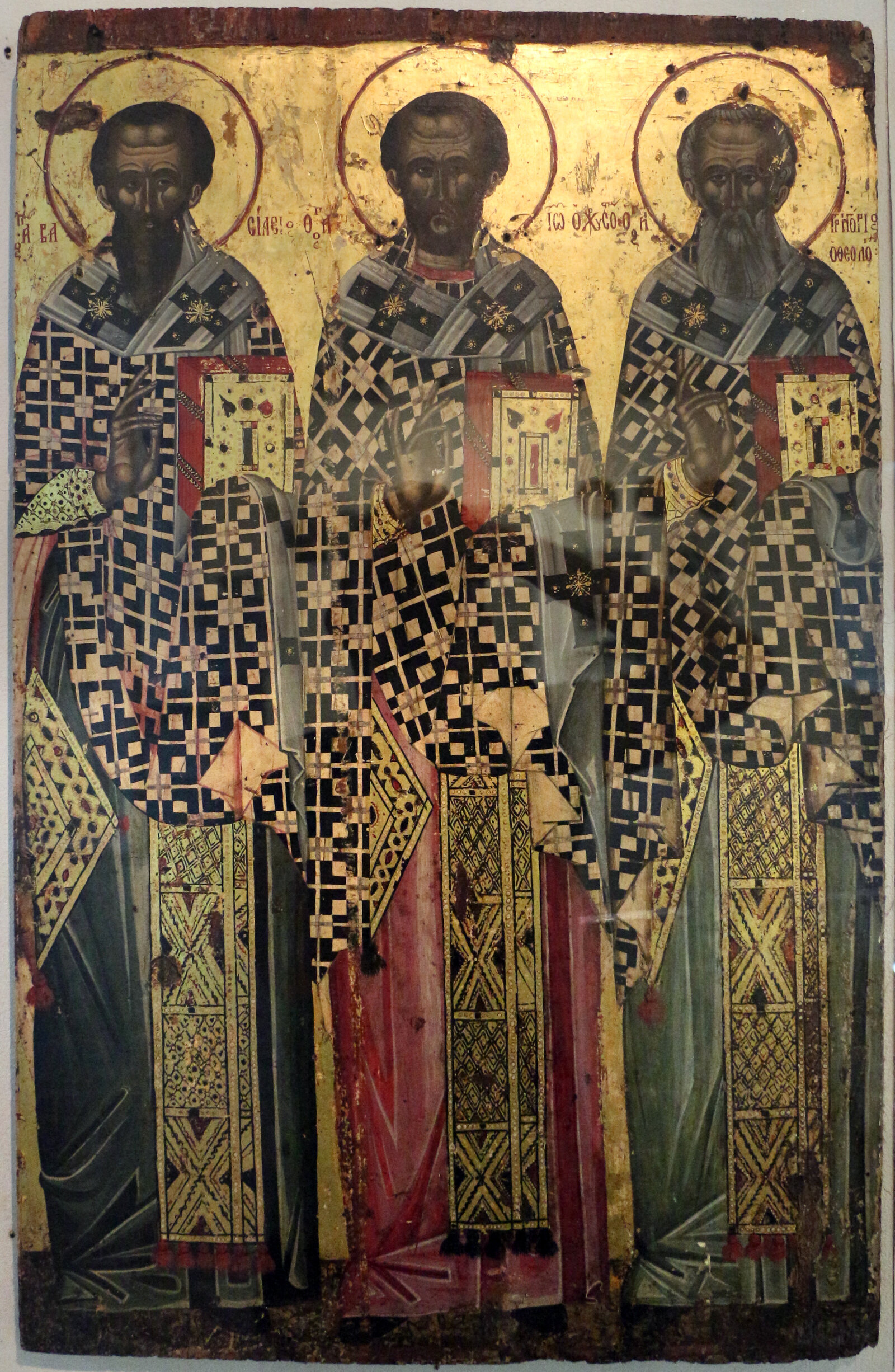
The Three Hierarchs
14th-c. Icon of Basil the Great, John Chrysostom, and Gregory the Theologian — National Historical Museum, Albania
Doctrinal reflection
These men taught the church how to think.
This 14th-century icon shows the Three Hierarchs — Basil the Great of Caesarea (left), John Chrysostom of Constantinople (center), and Gregory of Nazianzus the Theologian (right) — standing in episcopal vestments, each holding a gospel-book. The grouping was instituted as a feast in 1100 specifically to honor these three together: not warriors, not visionaries, not desert ascetics, but theologians. Their iconography differs from the saints we have looked at so far. They are not painted with weapons or martyrs' palms. They are painted with books.
Basil (c. 330–379) was bishop of Caesarea in Cappadocia, brother of Gregory of Nyssa, founder of monastic communities, defender of Nicene Trinitarian orthodoxy against the lingering Arian and semi-Arian factions of the late 4th century. His treatise On the Holy Spirit settled the question of the Spirit's full divinity for the church and is still the standard reference. He fed the poor of his diocese during the famine of 368 and built a hospital that bore his name for a thousand years.
Gregory of Nazianzus (c. 329–390) was Basil's friend, briefly Patriarch of Constantinople, presider over the First Council of Constantinople (381) which finalized the Nicene Creed. His Five Theological Orations on the Trinity are among the most refined ever written. He resigned the patriarchate within months because the politics disgusted him, retired to write theology, and earned the title Theologian — a title given to only three men in church history (the other two are John the Apostle and Symeon the New Theologian).
John Chrysostom (c. 347–407), "Golden-Mouthed," was Patriarch of Constantinople from 398 to 404. He preached his way through entire books of scripture in expository series and is the model of expository preaching for the Eastern church. His denunciations of imperial corruption — particularly of the empress Eudoxia's vanity — got him exiled twice. He died on the road during his second exile, having been forced to march in winter while in poor health. His last recorded words: "Glory to God for all things."
These three are Tier 2 in our citation framework — late patristic, doctrinally aligned, broadly safe to honor. Their teaching on the Trinity, on the incarnation, on prayer, and on Christian life under pressure is part of the patrimony GLM gladly receives. Hebrews 13:7: "Remember them which have the rule over you, who have spoken unto you the word of God: whose faith follow, considering the end of their conversation." That is the canonical instruction for handling teachers like the Three Hierarchs. Remember them. Follow their faith. Consider how they ended.
We do not pray to Basil or Gregory or Chrysostom. We do not light candles to them as patrons of theological inquiry or of preaching. The mediation belongs to Christ alone (1 Timothy 2:5). But we read what they wrote. We learn from how they taught. And we honor what their lives cost them — the famine-relief, the resigned patriarchate, the road to exile — because faithful teaching always costs something.
When you preach Christian doctrine, do not preach it as if you invented it. The Three Hierarchs handed it to you. Hand it to the next generation.