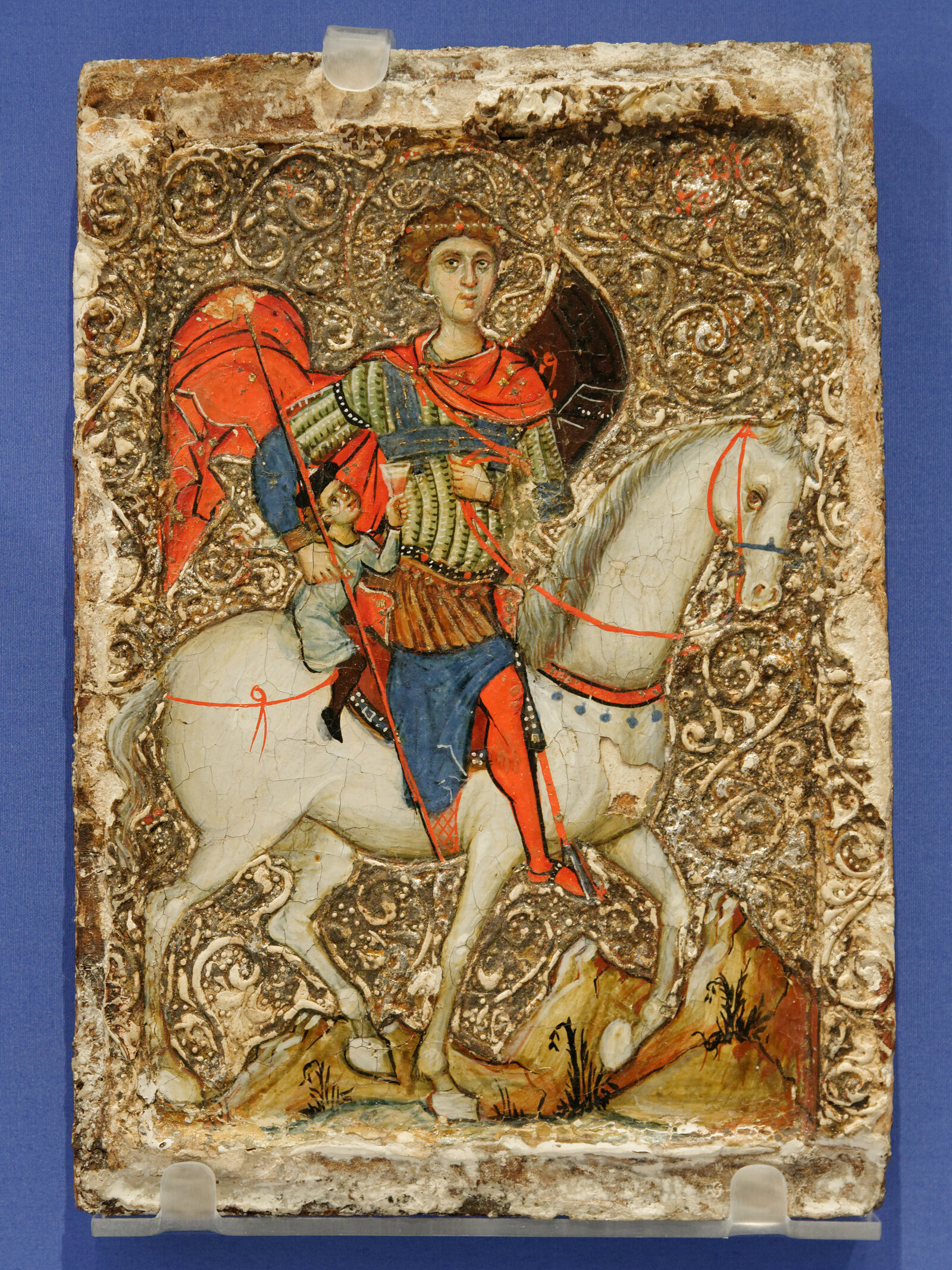
Saint George
13th-c. Byzantine Icon (with the Youth of Mytilene) — British Museum
Doctrinal reflection
He did not slay a dragon.
This 13th-century Byzantine icon at the British Museum shows Saint George on horseback in full armor, lance in hand, with a small figure mounted behind him on the same horse. The small figure is not a princess. He is a young man — a Christian boy from the island of Mytilene who, according to legend, had been taken captive by Saracens. George is shown rescuing him in a vision. This is not the dragon-slaying scene that medieval Western iconography made famous.
The iconography we have inherited is mostly legend. The historical core is sparse. George was a Roman soldier, probably from Lydda in Palestine, executed under Diocletian around AD 303 for refusing to participate in the imperial pagan cult. That is most of what is defensible. He died in the same persecution wave that killed Sergius and Bacchus and the Forty Martyrs of Sebaste. He was a real soldier-martyr.
The rest is medieval invention. The dragon legend first surfaces in an 11th-century Georgian text and reaches its full Western form in Jacobus de Voragine's Golden Legend in the 1260s — almost a thousand years after George's death. The princess, the dragon, the lance, the rescued city of Silena: late embellishments. The Mytilene episode shown in this icon is also legendary, though earlier than the dragon. None of it is historical.
We could just decline the legends and stop. But the iconography of George-slaying-the-dragon is doing something theologically real, even if it has the figure wrong. There IS a dragon-slayer in the canonical scripture. He is not a Roman cavalry officer. He is the Lamb. Revelation 12:7–11: "And there was war in heaven: Michael and his angels fought against the dragon... And the great dragon was cast out, that old serpent, called the Devil, and Satan... And they overcame him by the blood of the Lamb, and by the word of their testimony; and they loved not their lives unto the death." The dragon falls. The Lamb's blood is the weapon. The martyrs' testimony is the second-stage instrument. There is your iconography.
George belongs in the Revelation 12:11 line — "they overcame him by the blood of the Lamb, and by the word of their testimony." That is the historical George: a soldier whose testimony cost him his life. The iconography has confused him with the Lamb's larger work, putting him in armor on a horse with a lance against the dragon when in fact he overcame the dragon by being killed for the Lamb. The icon got the species right (the dragon is a real adversary) and the figure wrong (George is one of the testifiers, not the dragon-slayer).
We do not pray to Saint George. We do not invoke him as a battle-saint or a national patron — England, Russia, Georgia, Ethiopia, and others have done so for centuries; we decline. The dragon was already slain by the Lamb; the testifying army is being raised every generation. George is in that army. So are we.
When you preach the saints, do not preach the legend. Preach the canon. The dragon falls in Revelation 12. The Lamb did the work. The witnesses extend it.