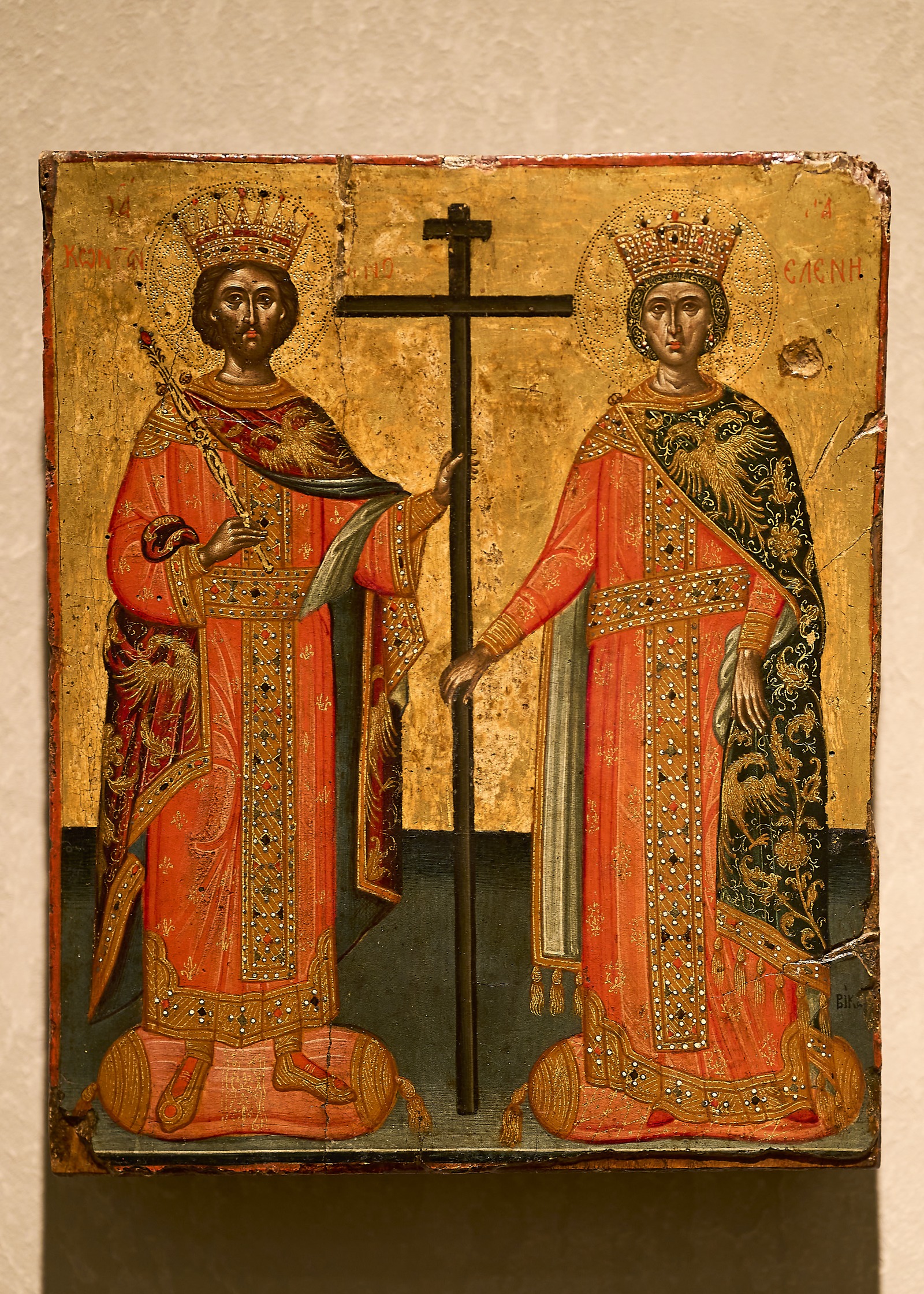
Saints Constantine and Helena with the True Cross
Panel Icon, c. 16th–17th century, post-Byzantine — Byzantine and Christian Museum, Athens
Doctrinal reflection
Two crowned figures stand on either side of a monumental cross. On the left: Emperor Constantine the Great (r. 306–337) in imperial regalia — gold crown, royal robes, ceremonial garb. On the right: his mother Helena (c. 246–330), also crowned, also robed. Between them: the True Cross, here rendered as the honored object of their joint witness. The icon is the canonical Byzantine iconographic type for the founders-of-Christian-empire — Constantine who legalized Christianity (Edict of Milan, 313) and ended Roman persecution of Christians; Helena who according to tradition discovered the True Cross during her 326 pilgrimage to Jerusalem. The icon is post-Byzantine Greek-Orthodox tradition, c. 16th–17th century, now at the Byzantine and Christian Museum, Athens. Athens museum at 3/4.
The historically defensible Constantine and Helena. Constantine's role in legalizing Christianity is historically documented (Lactantius's De Mortibus Persecutorum; Eusebius's Life of Constantine; the Edict of Milan in 313). Helena's pilgrimage to the Holy Land in 326 and her construction of churches at the holy sites is also historically attested. The discovery-of-the-True-Cross tradition is later (Ambrose c. 395; Rufinus c. 403; not in Eusebius), with apocryphal embellishment accumulating. The corpus reads the historical core (Constantine ended persecution; Helena built churches and patronized Christian sites) as canonical-tradition; the True-Cross-discovery as later patristic-tradition with elements that may be historical kernel + legendary expansion.
Collection 7 named-decline applied carefully. The Constantine-and-Helena cult historically grew large in the Byzantine and Russian Orthodox traditions; Constantine's birthday (May 21) is celebrated jointly with Helena. The veneration tradition has elements that slid past the apostolic line: Constantine as Equal-to-the-Apostles (Ἰσαπόστολος, Isapostolos) is a Byzantine title that the corpus reads as overreach — Constantine was not an apostle, was not commissioned by the risen Christ as the Twelve were, and the title functions to consecrate political-imperial rule with apostolic authority. The corpus's named-decline rule (locked corpus-wide since #43) handles this: affirm the historical-witness of Constantine's policy ending persecution and Helena's church-building patronage; decline the Equal-to-the-Apostles title that elevates them above the canonical apostolic role; refuse the iconoclast erasure that would remove them from iconography altogether.
The True Cross — Collection 5 typological cousin frame. The icon's central element is the cross itself, rendered as honored relic. The corpus reads the True Cross historically: Helena's tradition discovery may have surfaced an authentic relic of Christ's crucifixion (the historical archaeology is plausible but unverifiable); the relic-veneration that grew at the various True-Cross-fragment sites across medieval Christianity (Jerusalem, Constantinople, Rome, Genoa, etc.) slid into the Nehushtan-trajectory the corpus has named at Collection 10's framing rule. What scripture says about the cross is sufficient: 1 Cor 1:18 (the preaching of the cross is to them that perish foolishness; but unto us which are saved it is the power of God), Galatians 6:14 (God forbid that I should glory, save in the cross of our Lord Jesus Christ). The cross as preached is the apostolic locus; the cross as relic is the Nehushtan-trajectory.
The compositional theology — saints flanking, cross at center. The composition places the cross at the iconographic center, Constantine and Helena as flanking witnesses. The eye-line-as-doctrine principle (locked at #72 Climacus) operates: the viewer's eye runs through the saints to the cross at the center; the saints are flanking-witnesses, not central-objects. Their compositional position prevents Constantine-or-Helena from becoming the central focus; the cross — and the gospel-power of the cross — remains the iconographic content.
Athens museum continues. The corpus's Athens-museum program now reads as a coherent post-Byzantine Greek-tradition catalog: Visitation (#94 Coll 2, 1751 Panagia-Delphi origin) + Archangel Michael icon (#109 Coll 8, c. 14th-c. Constantinople workshop) + Constantine-Helena icon (this entry, Collection 4 saints, c. 16th-17th c.). Three doctrinal angles, three eras, all post-Byzantine Greek-Orthodox iconographic tradition. Plus the workshop/tradition/icon-type entries (Damaskenos, Christopher, Hodegetria) tracked separately under the #84.5 convention. Athens museum at 3/4 active.
Constantine ended persecution. Helena built churches and (perhaps) found the relic. They flanked the cross in iconographic memory. The corpus honors their witness while declining the Equal-to-the-Apostles expansion and the relic-veneration trajectory. The cross at the center is the gospel; the saints around it are witnesses to the cross's power.