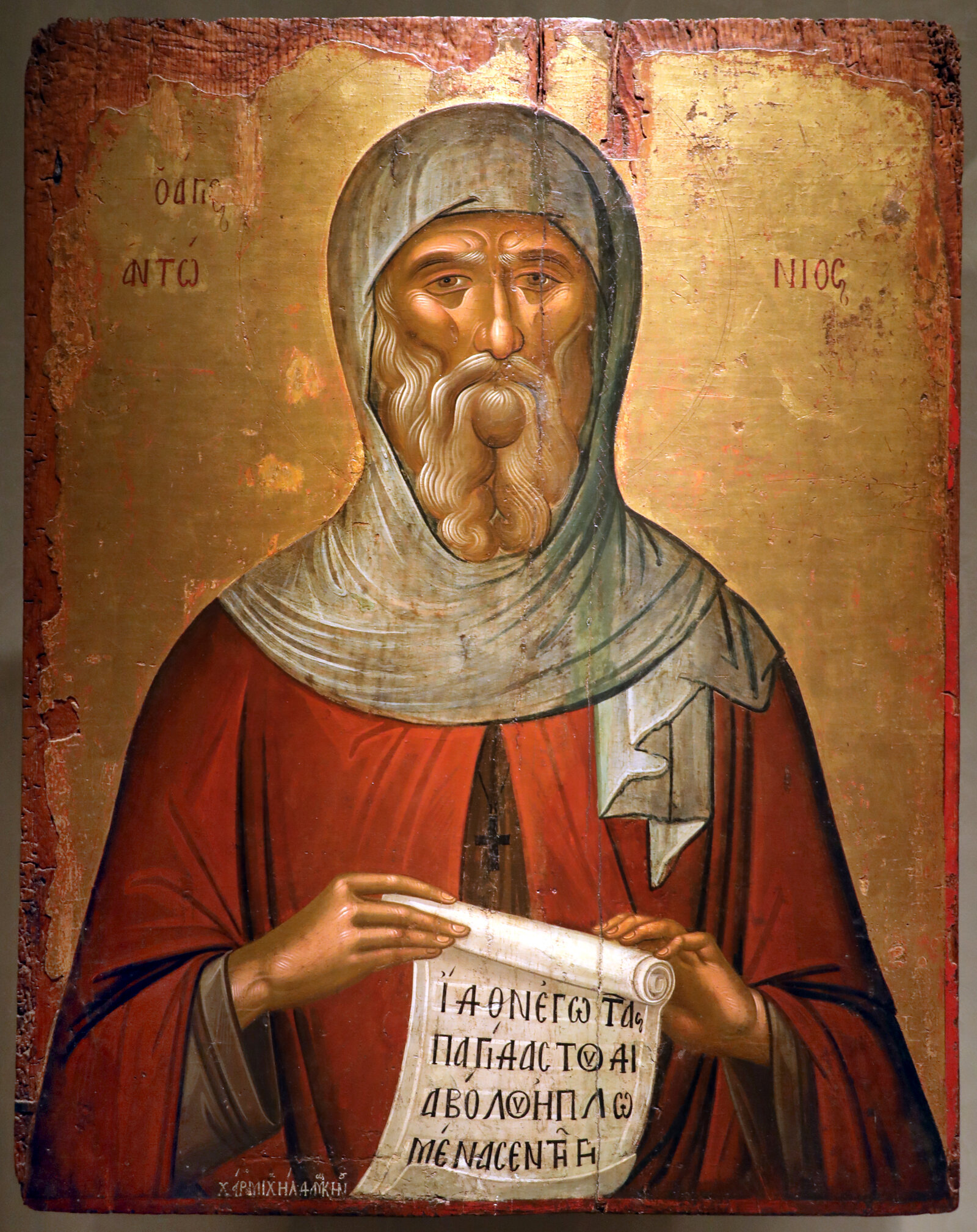
Saint Anthony of the Desert
Icon by Michael Damaskenos, c. 1550–1600 — Byzantine and Christian Museum, Athens
Doctrinal reflection
He went into the desert and prayed for eighty years.
This 16th-century icon by the Cretan Renaissance painter Michael Damaskenos shows Saint Anthony of the Desert in the standard Byzantine monastic format: long white beard reaching to his chest, dark monastic habit, scroll in one hand, his right hand raised in blessing. Damaskenos painted Anthony as he had been remembered in monastic tradition for twelve hundred years: the founder of Christian monasticism, the first ascetic to withdraw to the Egyptian desert for sustained prayer.
Anthony's history is unusually well-attested for a 4th-century saint. Athanasius of Alexandria — Tier 2 Patristic, contemporary of Anthony — wrote the Life of Anthony within a year of Anthony's death in 356 AD. Athanasius had met Anthony personally, talked with him during Anthony's brief returns from the desert to Alexandria, and based the biography on direct testimony. The book became one of the most widely read Christian texts of late antiquity. Augustine credits reading it as a turning point in his conversion (Confessions VIII).
Anthony was born around 251 AD to a wealthy Egyptian Christian family. At age 18, hearing the words of Matthew 19:21 — "If thou wilt be perfect, go and sell that thou hast, and give to the poor, and thou shalt have treasure in heaven: and come and follow me" — read in church, he sold his estate, gave the proceeds to the poor, and withdrew first to a tomb on the edge of his village, then to an abandoned fortress in the Egyptian desert, where he lived alone for twenty years. By his middle age the desert had filled with imitators; he had become, almost against his will, the founder of a movement.
The iconography shows him austerely. No legendary embellishments, no demonic combat scenes (those exist in Western art but the Eastern tradition usually keeps the icon spare), no Western-style hand-feeding-by-ravens (that motif belongs to Anthony's friend Paul of Thebes anyway). What is shown is a man, a beard, a habit, a scroll. Damaskenos's painting is faithful to the Byzantine convention.
Anthony is GLM-relevant in two specific ways. First, his founding act was a literal obedience to a specific verse heard read aloud — Matthew 19:21. Anthony took the verse as it stood and acted on it. The corpus's locked-in commitment to scripture-as-canon-authority finds, in Anthony, an early and dramatic instance of that exact orientation. He read the text and went.
Second, Anthony's withdrawal-for-prayer is biblically rooted (Christ withdrew to pray; Mark 1:35; Luke 5:16) even if the institutional monasticism that grew from his example is not biblically required. We can honor Anthony's prayer-discipline and scripture-saturation without endorsing perpetual celibate monastic life as a normative Christian path. The pattern: imitate what scripture commends; decline what is institutional accretion.
We do not pray to Anthony. We do not invoke him as patron of monks, of the dying, or of skin diseases (the medieval Western cult). The mediation belongs to Christ alone (1 Timothy 2:5). But we read his life with profit. He withdrew. He prayed. He read scripture for half a century. He lived to over 100. He was buried in the desert at his own request, in an unmarked grave, so that no cult could grow around the body.
He meant for that. We honor him by honoring it.
When you preach the Christian life, do not require monasticism. But preach the prayer-discipline. Anthony heard a verse and acted on it. The verses we hear are still asking for the same.