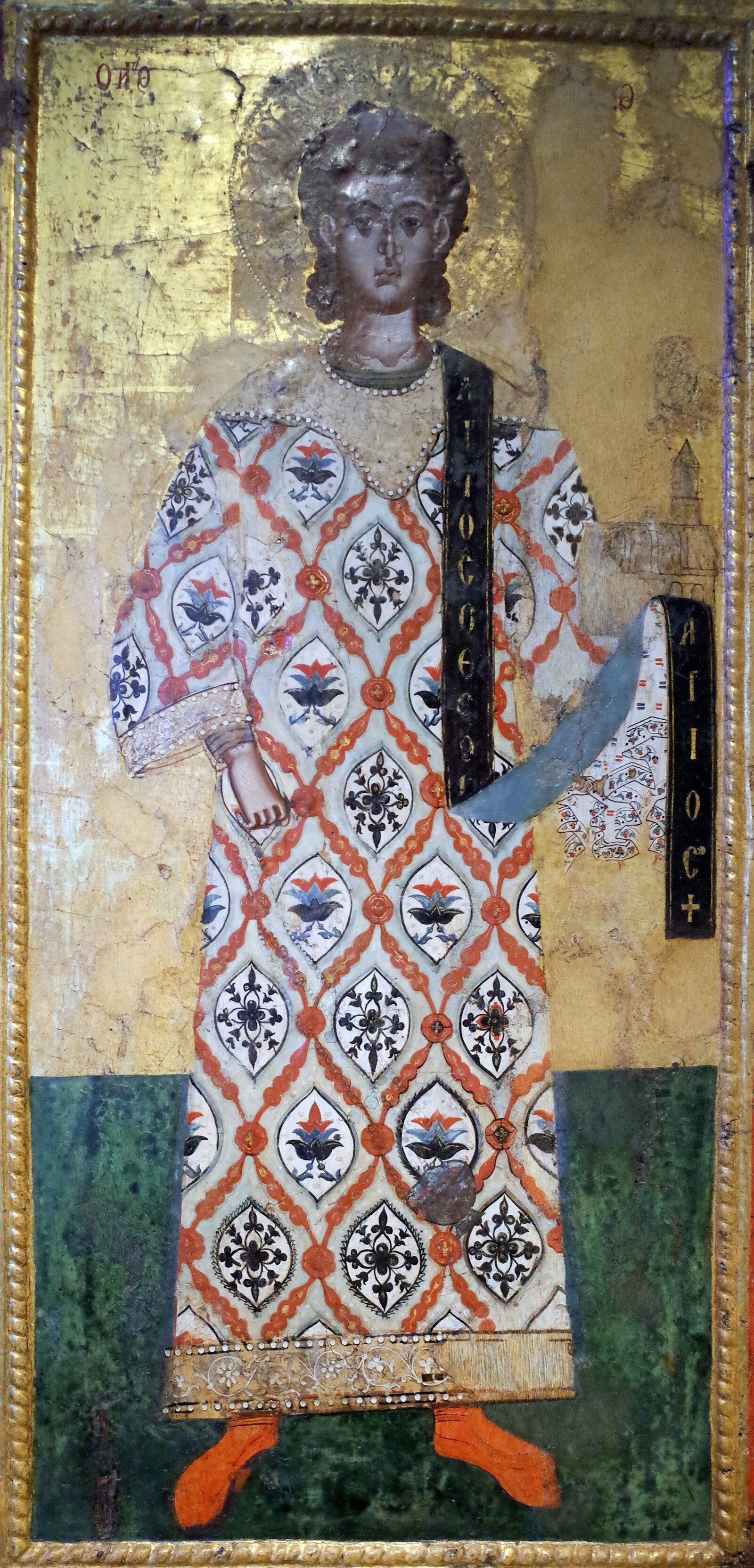
Saint Stephen the Protomartyr
Greek Icon (17th c., Byzantine Tradition) — Museum of Byzantine Culture, Thessaloniki
Doctrinal reflection
He is the easiest saint to preach.
Saint Stephen is in the Bible. Acts 6 names him. Acts 7 records his sermon. Acts 7:55–60 narrates his death. We do not have to argue from tradition or weigh apocryphal accretions. Stephen is canonical, and the canonical record is the entire theology of his iconography.
This 17th-century Greek icon, in the Museum of Byzantine Culture at Thessaloniki, shows him in the standard Byzantine iconographic format: deacon's vestments (the sticharion and the orarion — the long white garment and the diagonal stole of the diaconate), a censer in his right hand, a small model church or a martyr's crown in his left, and the title Protomartyr ("first martyr") inscribed in Greek above his head. The Byzantine tradition treats Stephen as both the first deacon (Acts 6:5) and the first martyr (Acts 7:60), and the icon shows both vocations in one figure.
Look at what Stephen did before he died. Acts 7:56: "And [he] said, Behold, I see the heavens opened, and the Son of man standing on the right hand of God." That is the only place in the New Testament outside the gospels where the title "Son of man" appears on the lips of a believer rather than on the lips of Christ. Stephen used Christ's own self-designation in his last sentence. He was looking at his Lord.
Then Acts 7:60: "And he kneeled down, and cried with a loud voice, Lord, lay not this sin to their charge. And when he had said this, he fell asleep." That second sentence is Christ's prayer from the cross (Luke 23:34) repeated by his servant. Stephen died praying what Christ prayed. The protomartyr is the first to follow the Lord all the way through.
The Collection 7 framing rule applies here, but it applies easily. Stephen is biblical; we don't have to chip apocryphal accretions away. We honor him as Hebrews 11–12 honors faith-witnesses: as exemplar, not as intercessor. The communion of saints is real; the icon names a real man whose race is finished; we are still running ours.
The icon shows him with a censer because his diaconate is part of his witness. In the Byzantine tradition, deacons carry incense at the liturgy as a symbol of the prayer ascending to God (Revelation 5:8). Stephen's life was that incense. He served tables (Acts 6:2–3); he preached the longest sermon in the New Testament (Acts 7); he prayed his enemies' forgiveness as he died. Service, preaching, prayer-of-forgiveness — that is the diaconate, and that is the martyrdom.
When you preach Stephen, do not preach him as a sad story. Preach him as the canonical pattern of how a Christian dies. He saw heaven opened. He saw Christ standing. He prayed for his killers. Then he fell asleep.
Go and do likewise.