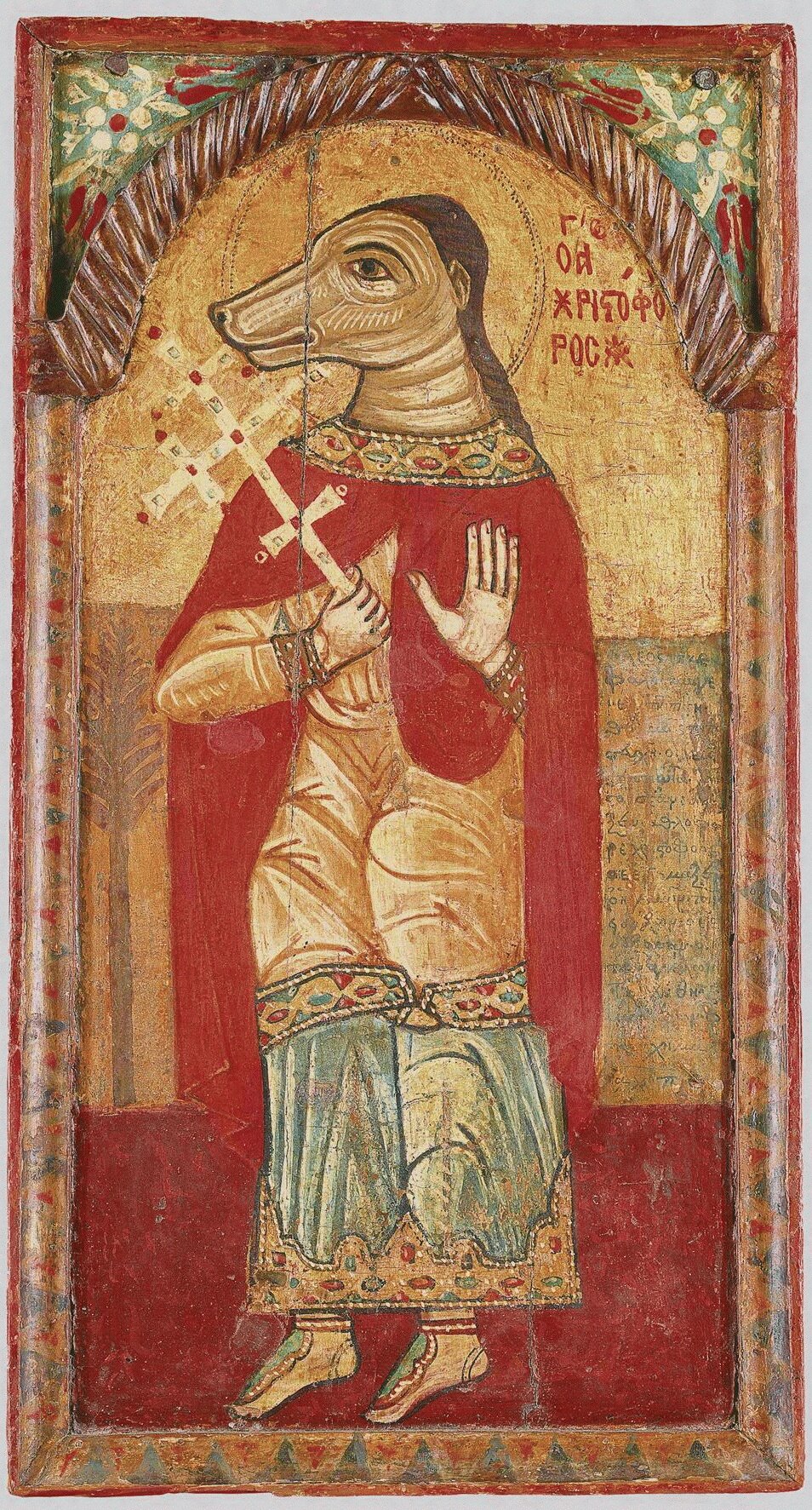
Saint Christopher Cynocephalus
17th-c. Eastern Icon (Dog-Headed Type) — Byzantine and Christian Museum, Athens
Doctrinal reflection
He has the head of a dog. We need to talk about that.
This 17th-century icon, in the Byzantine and Christian Museum in Athens, shows Saint Christopher with the body of a man and the head of a dog. He is fully vested as a martyr — palm branch in one hand, cross-staff in the other — and his snout is unmistakably canine. This is not an isolated curiosity. The dog-headed Christopher (Greek kynokephalos) is a recognized iconographic type with multiple surviving examples across the Eastern Christian tradition, particularly in Greek and Slavic sources from the late medieval and early modern periods.
The iconography is wrong. Probably it began as a textual confusion: the Latin source called Christopher Cananeus — a Canaanite — and somewhere in the Greek reception this was misread as caninus (dog-like) or conflated with classical-pagan stories about cynocephali, dog-headed men of distant lands. The error became iconography. The iconography became cult. By the time it appears as a settled type, no one was pulling it back.
The historical Christopher is also problematic. The Vatican removed his name from the Roman calendar of universal saints in 1969 because his historical existence could not be substantiated. Some early Christian witness to a Christopher martyred in Asia Minor under Decius (c. 250 AD) survives, but the figure is unrecoverable through legend. The giant who carried the Christ-child across the river — the most famous Christopher story in the West — is a 13th-century narrative with no early attestation.
What do we do with an icon that gets the species wrong, depicts a saint whose history is largely lost, and has been venerated for centuries as patron of travelers and protector against sudden death? The locked-in rule applies cleanly: we affirm what is biblically warranted; we decline what is not.
What is biblically warranted: martyrdom under Roman persecution is real. Many Christophers (the name means "Christ-bearer") have died for the faith over twenty centuries. Whether or not a specific Christopher of the 3rd-century legend existed, the witness of named-and-unnamed martyrs across that period is canonical fact, attested in Hebrews 11:36–38 and Revelation 6:9–11. The category of Christ-bearer is real even when a specific named instance cannot be substantiated.
What is not biblically warranted: the dog head, the legendary giant-carrying-Christ-across-the-river story, the medallion-of-Christopher-as-protection-from-death superstition. Decline all of it.
A pastoral note. Faithful believers have venerated this icon for centuries. We do not mock them. They were doing the best they could with what their tradition handed them. God is not mocked by misidentified icons; He receives the honor offered through them when the heart was sincere, even when the iconography was confused. But the honor was always meant for him. The icon's confusion does not invalidate the worshipper's intent; it does, however, reveal why we read scripture rather than tradition as our primary guide.
When you preach the saints, name what you cannot confirm. Decline the legends. Honor the category — Christ-bearer — and let the canonical record provide the figures. Hebrews 11 has plenty.