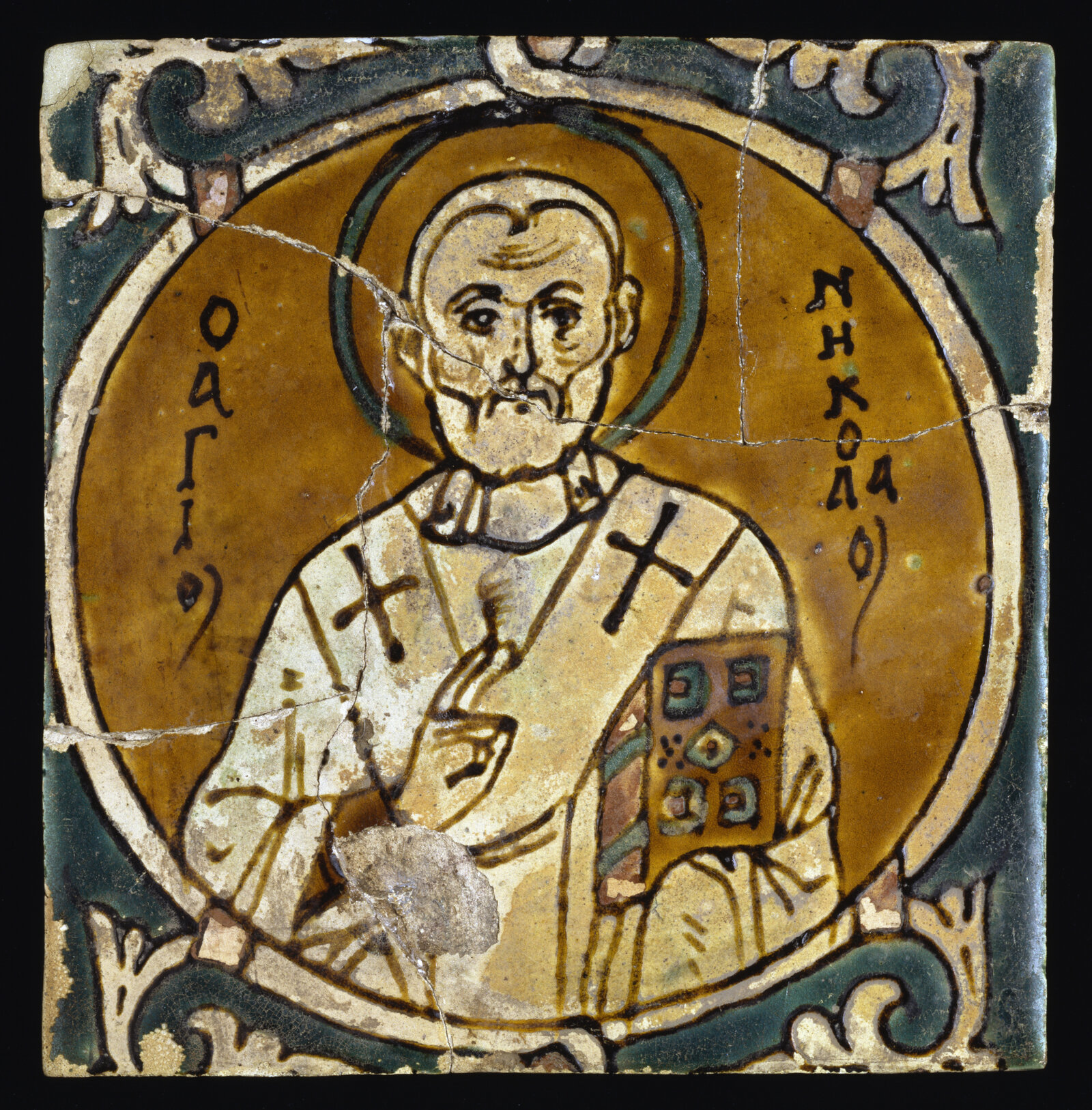
Saint Nicholas
10th-c. Byzantine Ceramic Icon Tile, Constantinople — Walters Art Museum
Doctrinal reflection
He is the most famous saint in the world. Almost everything you have heard about him is legend.
This 10th-century Byzantine ceramic tile, made in Constantinople and now in the Walters Art Museum, shows Saint Nicholas in the standard iconographic format: bishop's omophorion (the white wool stole with crosses), right hand raised in blessing, left hand holding a gospel-book, eyes meeting the viewer. No reindeer. No red suit. No bag of toys. The tile predates the Santa-Claus mythology by nine hundred years.
The historical Nicholas is sparser than the legend. He was bishop of Myra in Lycia (modern Demre, southern Turkey), born around 270 AD, died around 343 AD. He is on the surviving bishop-lists from the Council of Nicaea in 325 — meaning he was a real bishop, present at the council that defined Christ's eternal coequal divinity against Arianism. He was probably imprisoned during Diocletian's persecution. That is most of what is historically defensible.
The rest is hagiographic accretion. The story of him slapping Arius at Nicaea is a late legend with no evidence; the contemporary acts of the council do not record it. The story of him resurrecting three murdered children pickled in a butcher's brine-tub is a 12th-century French embellishment with grotesque details that the early church did not know. The story of him secretly delivering bags of gold to a destitute father with three daughters to save them from prostitution is older and possibly historical at the core — but every dramatic flourish in the modern retelling cannot be verified.
We are honest about this because the corpus's commitment is to scripture and to history that scripture warrants. Hebrews 11–12 names faith-witnesses; we honor what is historically defensible about Nicholas's faith and decline what is not. Acts 4:19–20 — we cannot but speak the things which we have seen and heard — likely fits the historical Nicholas, who endured imprisonment under Diocletian. Beyond that, much of the cult is later development.
We do not pray to Saint Nicholas. We do not light candles to him as intercessor of sailors, of children, of pawnbrokers, or of secret gift-givers. The mediation work belongs to Christ alone (1 Timothy 2:5). We do not need Nicholas's legendary biography to honor his historical witness — and we should not, because importing legend into preaching weakens the gospel by tying it to claims that cannot be defended.
What is worth keeping from Nicholas's iconography is exactly what this 10th-century tile shows: a bishop in vestments holding the gospel and blessing the viewer. That is what a faithful pastor does. The blessing is real. The gospel is real. The man who held both faithfully in 4th-century Lycia is part of the cloud of witnesses surrounding us. What he was not, and never claimed to be, is a magical figure to invoke for protection.
When you preach Nicholas, preach a bishop, not a legend. Preach what survives historical scrutiny. Decline the rest.