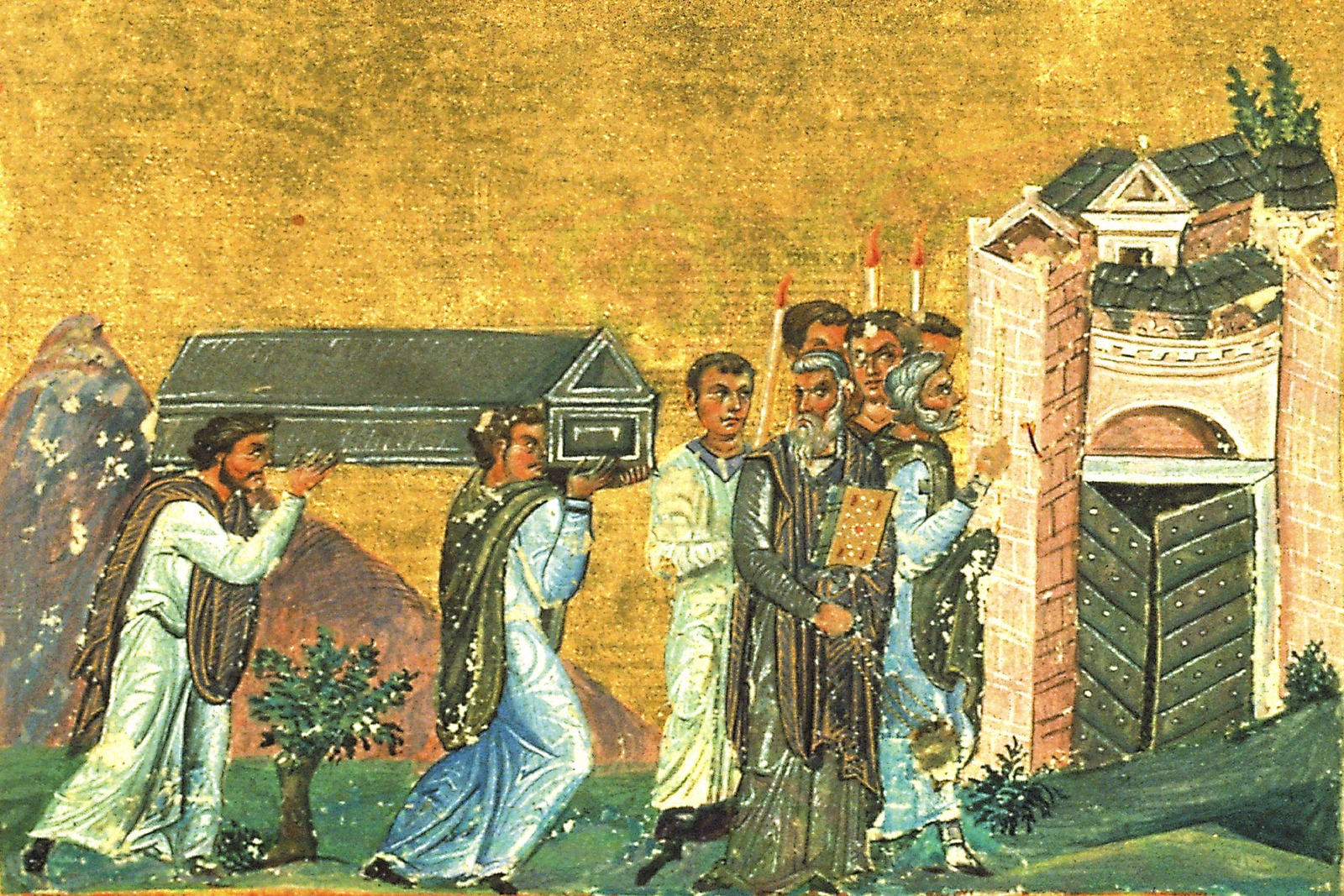
The Martyrdom of Ignatius of Antioch
Menologion of Basil II — c. 985, Constantinople (Vatican Library, Vat. gr. 1613)
Doctrinal reflection
An aged bishop in episcopal vestments stands at the center of the iconographic frame, hands raised in supplicating posture toward heaven. To the right, two lions emerge from a small enclosure to seize him. The composition renders Ignatius of Antioch's martyrdom in the Roman arena (c. 110) — the first post-apostolic bishop named as a martyr in canonical sources. The Menologion of Basil II's Collection 4 register depicts the saint at the moment of his death in the apostolic-witness register: facing the lions, hands raised, episcopal dignity intact. The folio is c. 985, the corpus's second Menologion entry alongside #menologion-basil-second-nicaea (#67). Menologion of Basil II at 2/3.
The historically defensible Ignatius — apostolic-era proximity. Ignatius of Antioch (c. 35–110) was bishop of Antioch in Syria, a major early Christian center. He was arrested under Trajan and transported to Rome for execution in the arena. Along the way he wrote seven letters (to the Ephesians, Magnesians, Trallians, Romans, Philadelphians, Smyrnaeans, and Polycarp) that survive as some of the earliest post-apostolic Christian writings. The corpus reads Ignatius as canonical-near-apostolic-witness — his bishop-of-Antioch position links him directly to the apostolic-era church (Acts 11:26 names Antioch as the place where the disciples were called Christians first); his letters cite Pauline texts already as scripture; his martyrdom under Trajan dates to within 70 years of Christ's resurrection.
Collection 4 framework — 15th-flagship cloud-of-witnesses pattern-match. The corpus's locked Collection 4 reading: saints witness, do not mediate. Ignatius's martyrdom-iconography is exactly the Heb 12:1 cloud-of-witnesses register — seeing we also are compassed about with so great a cloud of witnesses, let us lay aside every weight, and the sin which doth so easily beset us, and let us run with patience the race that is set before us, looking unto Jesus. The corpus reads the iconography: Ignatius witnessed; we look at him as Hebrews directs (compassed-about); we look through him to Jesus (looking-unto-Jesus). The compositional theology of the Menologion folio renders this — Ignatius's eyes turn upward toward heaven, not at the lions, not at the viewer; the saint looks at God, the corpus looks at the saint, the corpus follows the saint's eye-line to God.
Ignatius's own theology — the corpus's careful reading. Ignatius's letters contain the earliest extant post-apostolic articulation of the bishop's role in the church — phrases like do nothing apart from the bishop (Smyrnaeans 8) became foundational for the later Catholic episcopal-monarchical tradition. The corpus reads Ignatius's bishopology carefully through the three-fence rule: affirm the historical reality of bishops in the early church (the apostolic NT names episkopoi — Acts 20:28; Phil 1:1; 1 Tim 3:2; Titus 1:7 — and Ignatius extends the pattern); decline the doctrinal expansion that turns the early-bishop-pattern into mandatory monarchical-episcopal ecclesiology (the NT also names elders/presbyters as the same office — Acts 20:17–28 calls the same group elders and bishops; Titus 1:5–7 uses both terms interchangeably); refuse the modern-liberal reduction that erases bishops from early-church history altogether. Ignatius is a witness to bishop-as-pastoral-overseer; later traditions read more into him than his letters warrant.
The Menologion's compositional restraint. The Menologion of Basil II's iconographic discipline is consistent across its 430 saint-illuminations: the saint at the center of a small landscape; the moment of martyrdom rendered in restrained iconographic register; the Greek inscription identifying the saint and the date in the church calendar. The Menologion does not amplify the polemical-vitriol register often associated with martyrdom-iconography (the persecutors are not demonized; the moment of death is rendered with iconographic dignity). The polemical-restraint standing rule (formalized at #142) operates here in martyrology register.
The Menologion as a calendar-of-witnesses. The manuscript's purpose is liturgical — to provide a folio-per-day reading for the saints commemorated through the year. The corpus reads the Menologion under the Collection 4 framework: it is a catalog of witnesses organized for the church's annual remembering. The saints in their proper days, the church remembering them in succession through the year. The Heb 12:1 cloud-of-witnesses given a calendar shape.
Ignatius stood. The lions came. He was killed in the arena. He looked up at heaven. The Antiochene bishop's witness was preserved in seven letters and one folio; the cloud-of-witnesses received him; the church remembers him on October 17 (his feast day). Looking unto Jesus, the author and finisher of our faith.