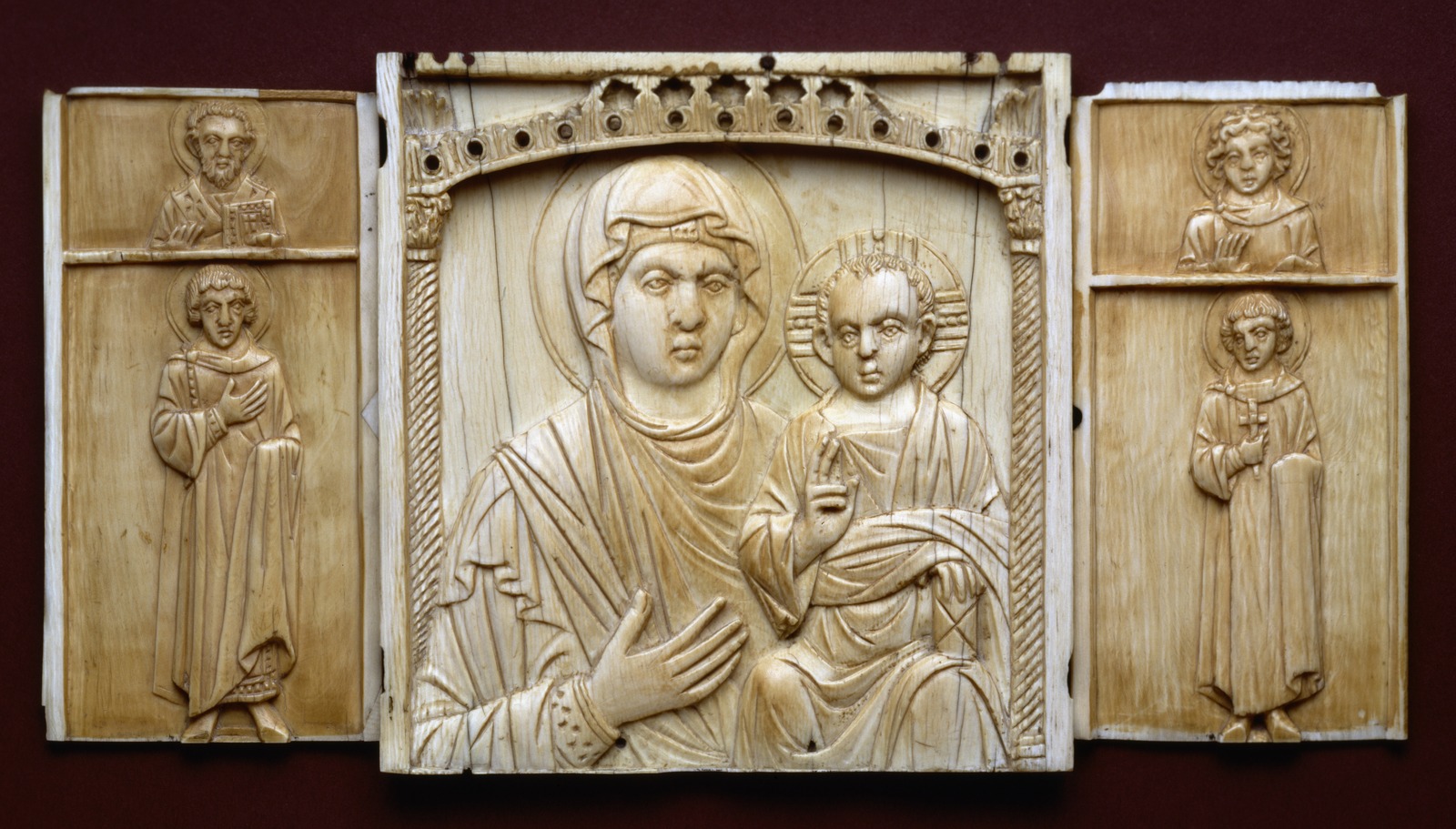
Triptych Icon of the Virgin and Child with Saints
Carved-Ivory Triptych, c. 10th century, Constantinople — Walters Art Museum (Acc. 71.158)
Doctrinal reflection
A small carved-ivory triptych, only 12 cm tall — small enough to hold in two hands. The central panel: the Theotokos seated, holding the Christ-child on her lap, her right hand pointing to him. The two wing panels: standing saints — bishops on the left wing, military saints on the right — flanking the central scene. The whole assembly is a portable iconostasis, fitting in a traveler's bag. The triptych is c. 10th-century Constantinople workshop, now at the Walters Art Museum, Baltimore (Acc. 71.158). The corpus's second Walters museum-housed entry alongside saint-nicholas-walters (the Cretan-school panel icon at #51). Walters museum 2/4.
The Hodegetria gesture at portable scale. The corpus has the Hodegetria type at the Torcello apse (#117) — 6 meters tall, monumental. The Walters triptych renders the same iconographic gesture at 12 cm — devotional miniature. The compositional theology survives the scale change. Mary's right hand still points to Christ; the gesture-as-doctrine principle (locked at #117 Torcello) operates at portable scale exactly as at apse scale. The 17th-flagship pattern-match (Theotokos-not-Mediatrix, locked at #88 Met Koimesis ivory): Mary is honored at every scale; the honor terminates in Christ at every scale. Whether the iconography is 6 meters or 12 cm, the doctrinal architecture holds.
The flanking saints — Collection 4 cousin frame. The two wings carry standing bishops and military saints — figures from the apostolic and post-apostolic witness tradition. Collection 4 (saints) cousin frame applies: the saints stand as cloud-of-witnesses (Heb 12:1, locked at #83 Rotunda) flanking the central Theotokos-and-Christ. The compositional structure: Christ at the center via Mary's gesture; saints flanking; the worshipper's eye runs from saints inward to Christ. They watch with us; we do not pray to them; the central figure they all flank is the One worshipped.
The portable-devotional medium. Ivory triptychs of this scale were made for personal use — high-status owners (court officials, military commanders, ecclesiastical hierarchs) carrying them in travel for daily prayer. The corpus has handled portable-devotional medium critique at #114 Met serpentine pendant (apotropaic-use named-decline). The triptych is the higher-status equivalent: not worn against the body but carried for visual catechesis. The corpus reads it as legitimate visual-prayer prompt while declining the mediation-magic register that sometimes attached to portable Byzantine devotional objects.
The ivory-medium category continues. The corpus opened ivory as a fresh medium at #88 (Met Koimesis ivory). The Walters triptych extends ivory at 10th-century Macedonian-Renaissance period — the era of Constantinopolitan ivory carving's highest development. Ivory accumulation tracks the Byzantine elite-devotional medium as a discrete category. Pattern: ivory carries Christological iconography at portable scale across the 10th–12th centuries, then declines as supply diminishes (the African elephant ivory trade suffered through the 11th century).
The Macedonian Renaissance compositional confidence. The 10th century is the Constantinopolitan high-craft moment after the iconoclasm settlement (843). The Macedonian dynasty (867–1056) supervised the period of greatest iconographic restoration; ivory carving at this scale demonstrates the empire's reclaimed iconographic vocabulary. The Walters triptych's compositional clarity — Theotokos central, saints flanking, gesture pointing inward to Christ — is the iconographic confidence of a tradition that has settled its own doctrinal questions.
The Theotokos points to Christ at 12 cm scale. The saints flank as witnesses. The triptych folds; the worshipper takes the gospel with them on the road. Mary honored at every scale; the honor terminates in Christ at every scale.