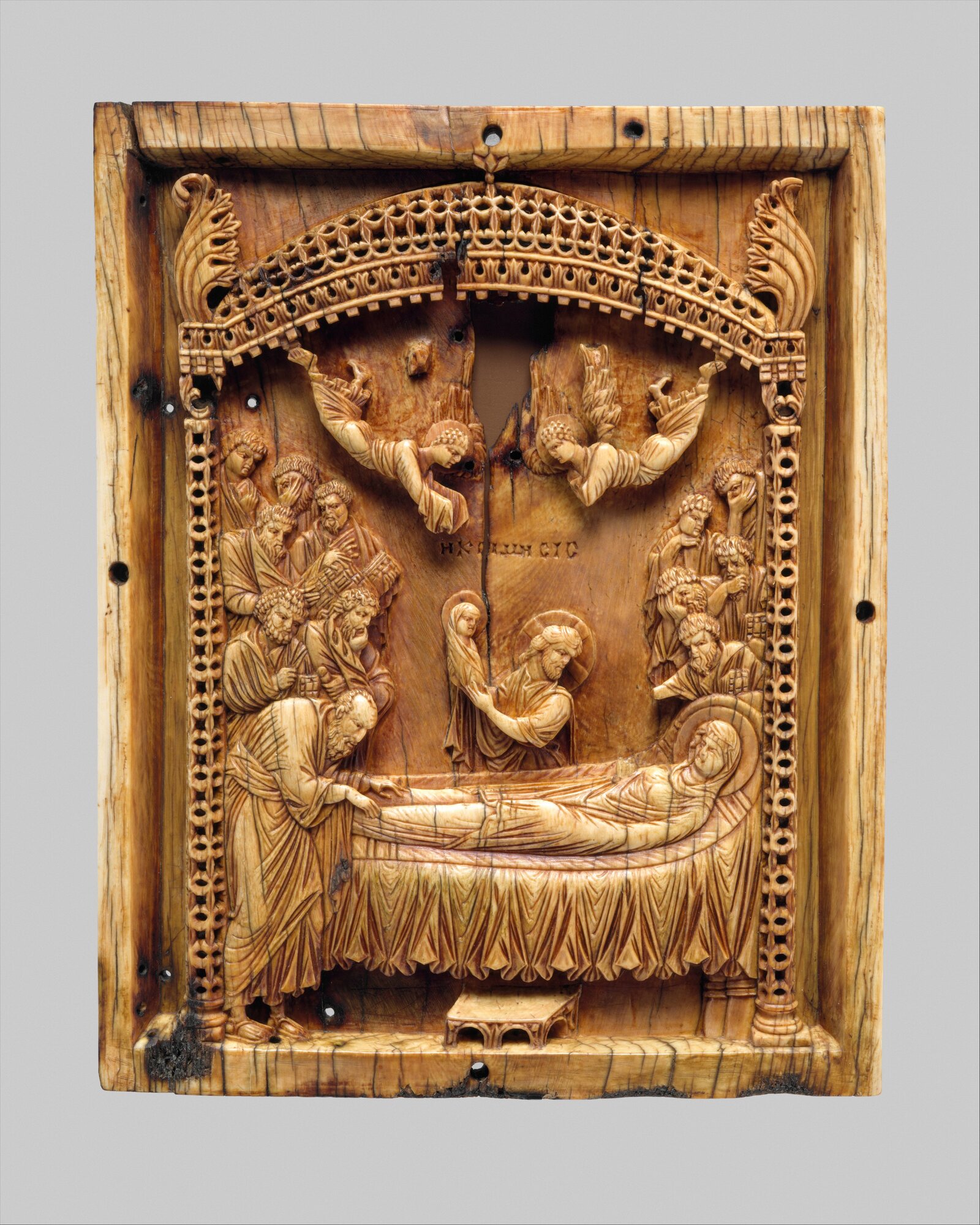
The Dormition of the Theotokos
Byzantine Ivory Plaque, late 10th century — Metropolitan Museum of Art (acc. 17.190.132)
Doctrinal reflection
Mary lies on the bier, hands crossed, eyes closed. Christ stands behind her, cradling in his arms a small swaddled-infant figure — Mary's soul, rendered as a child wrapped in cloth. Peter stands at the head with a censer; Paul bends over Mary's feet. Other apostles crowd between. Two angels descend from above. The single ivory plaque, 18.6 × 14.8 cm, late 10th century, is a Macedonian Renaissance commission from a Constantinople workshop, now at the Metropolitan Museum.
This is the 17th flagship articulation: the Theotokos honored but not Mediatrix.
The iconography enacts the doctrine. Standard Theotokos compositions show Mary holding the swaddled Christ-child — she is the giver, he is the gift. The Koimesis reverses the figures. Christ holds the swaddled Mary-soul; she is now the swaddled child; he is now the one who carries. The compositional reversal is the corpus's strongest single iconographic argument that Mary moves from giver-to-the-incarnation to recipient-of-Christ's-care. The order of grace runs from him to her. It does not run from her through him to us.
Affirm — Mary's honor as Theotokos. Elizabeth gives her the title at Luke 1:43: "Whence is this to me, that the mother of my Lord should come to me?" — conferred by another mother-of-a-prophet recognizing the greater pregnancy. Mary's own self-description in the Magnificat (Luke 1:46–55) is handmaiden (doulē), recipient of God's regard: "he hath regarded the low estate of his handmaiden." The corpus's existing throne-of-David reading at sinai-virgin-theodore-george and gesture-as-doctrine reading at theotokos-hodegetria are the affirm-side companions: Mary points to Christ in life, as Christ holds Mary in death.
Decline — the Mediatrix claim. 1 Timothy 2:5 — "For there is one God, and one mediator between God and men, the man Christ Jesus." The Greek heis mesitēs is numerically singular: one, not first-among-many. The medieval Latin and Eastern devotional traditions that elevated Mary to the role of Mediatrix omnium gratiarum — mediator of all graces, channel through whom every grace from Christ to the church must pass — go beyond what the apostles authorize. The strongest refutation comes from Mary herself: a handmaiden does not become a mediatrix. Mary's Magnificat is the structural undercut to her later elevation; the woman who said be it unto me and my soul doth magnify the Lord did not place herself between heaven and earth. The Koimesis confirms this. Mary is the one received, not the one receiving.
Refuse — the over-correction. The corpus does not strip Mary out of the incarnation in reaction to Marian-mediation overreach. Without her body the doctrine collapses (#sinai-virgin-theodore-george). The handmaiden's consent at Luke 1:38 — "be it unto me according to thy word" — is real consent, real obedience, real participation in the central act of redemption. The corpus refuses to make Mary either nothing or everything. The fiat is hers; the grace is the Lord's; the order is preserved.
Familial care, not cosmic intercession (John 19:26–27). From the cross Christ commends Mary to John: "Behold thy mother... Behold thy son." The Lord places his mother in domestic care, not in cosmic-mediation office. The post-resurrection church received her as a fellow believer in fellowship and prayer (Acts 1:14). Honored, fed, sheltered, prayed with — not prayed to.
Paired-flagship architecture. This 17th flagship pairs with the 15th flagship (#83 Cloud of Witnesses): same shape (witness/honor without mediation), different subject (saints generally / Theotokos specifically). Together with the Collection 7 named-decline rule and the Helvidian standing-rule lock, the corpus now has a four-piece anti-mediation architecture — each piece declining a different mediation-expansion (saint-cult petitionary mediation; perpetual-virginity-grounded Marian elevation; the Mediatrix claim itself; the cloud-as-intercessors claim). All four anchor in 1 Timothy 2:5. Heis mesitēs — one mediator — is the corpus's structural verse against any human-mediation expansion, whether apostolic (#75 Ananias / #78 Peter / #81 James), Petrine (#56), or Marian (#88).
Mary held Christ in life. Christ holds Mary in death. The order of grace runs from him to her, not from her through him to us.