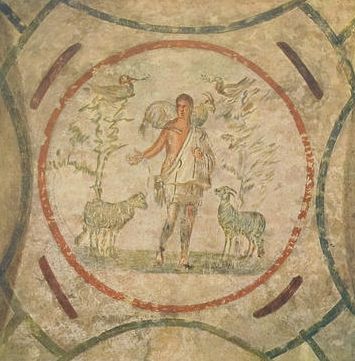
The Good Shepherd
Ceiling Fresco, Catacomb of Priscilla, Rome — c. 225 AD (Pre-Constantinian Early Christian)
Doctrinal reflection
A young beardless figure in a short tunic stands with a sheep across his shoulders, head turned to the right. Behind him, two trees with birds; at his feet, two more sheep approaching. The composition is the classic Good Shepherd iconographic type — Christ rendered through John 10:11 ("I am the good shepherd: the good shepherd giveth his life for the sheep"). The fresco is on the ceiling of a burial chamber in the Catacomb of Priscilla, Rome, dated c. 225 AD — one of the earliest surviving Christian iconographic representations of Christ. The corpus's first pre-Constantinian entry; the corpus's 150th entry at the milestone moment. Catacomb of Priscilla opens as fresh Roman site.
Pre-Constantinian Christian iconography — the apostolic-era proximity. The Catacomb of Priscilla was in active use as Christian funerary space from the late 2nd century. The Good Shepherd fresco c. 225 means the image was painted within ~190 years of Christ's resurrection — closer in time to the apostolic generation than Augustine, Chrysostom, or Athanasius. The earliest surviving Christian iconography postdates the apostles by about 150-200 years. This is the iconographic-evidence-window the corpus has reached.
Collection 1 Pantocrator framework — Christ-as-Lord in pastoral register. The Good Shepherd composition reads as Collection 1 (Christ-as-Lord) in a distinctive iconographic register: not the enthroned-cosmocrator of later Byzantine domes (which the corpus has covered exhaustively), but the shepherd-bearing-the-sheep of John 10's discourse. The doctrinal claim is identical: Jesus is Lord. The compositional vocabulary is different: not the imperial-court vocabulary of post-Constantinian iconography, but the pastoral-rural vocabulary of pre-Constantinian funerary devotion. The Iconographic-survival principle (#70) applied at the longest temporal scale: the Lordship-of-Christ doctrine survives across the iconographic vocabulary-shifts from rural shepherd to imperial cosmocrator without changing the doctrinal content.
Collection 1 freeze lifts at this milestone. The corpus's Collection 1 freeze (locked at #94 audit when Pantocrator at 16/107 = +5.3 over avg) lifts at this 150th entry: at 147 entries / 10 colls = avg 14.7, Collection 1 at 17 = +2.3 over avg, within the +5 freeze threshold. The Good Shepherd entry both opens fresh iconographic territory (Roman catacomb) and resolves the Collection 1 distribution issue.
The classical iconographic borrowing — Orpheus parallel. The Good Shepherd composition draws from pre-existing Roman pastoral iconography, including the kriophoros (ram-bearer) type of classical Greek sculpture and the Orpheus-among-the-animals Roman pastoral register. The early Christian iconographer borrowed pagan-Roman visual vocabulary and reframed it Christologically — exactly the pattern the corpus has named at #108 Paris Psalter and #121 Vienna Genesis Rebecca (classical-personifications imported into Christian biblical illustration). The borrowing was not theological compromise; the borrowing was vocabulary-import, with the Christological content (John 10's Good Shepherd discourse) supplying the doctrinal anchor.
John 10:11 — the apostolic-doctrinal anchor. "I am the good shepherd: the good shepherd giveth his life for the sheep." The verse anchors the corpus's reading: the iconographic image teaches what John 10's Christ taught — the shepherd lays down his life for the sheep. Christ is not the shepherd-as-protector-only; Christ is the shepherd-who-dies-for-the-flock. The Catacomb of Priscilla painter rendered this doctrinal content for a community of Roman Christians who themselves were dying (literally — the catacomb is a burial chamber; the painted Christians were dead under Roman persecution). The Good Shepherd fresco assured the dying community: the One whose image we paint is the One who died for us; we die in him; he carries us across.
The corpus's milestone — 150 entries. The corpus reaches 150 entries with this pre-Constantinian Good Shepherd. The arc spans c. 225 AD (this entry) to c. 1700+ AD (Tzanes, Ulanov, late Cretan school) — roughly 1500 years of iconographic continuity. The doctrinal core stayed stable across the millennium-and-a-half: Christ became flesh; Christ died; Christ rose; the church gathers around the apostolic memorial of his work; Mary is honored, not Mediatrix; the saints witness, not mediate; angels minister, not mediate; the cross is central; the Spirit is given. The 150 entries together render the apostolic line in iconographic form across the geographic and temporal sweep of the Byzantine and post-Byzantine traditions.
The young shepherd carries the sheep on his shoulders. The sheep approach from below. The trees frame the scene. The Roman catacomb preserved the image for 1800 years. I am the good shepherd: the good shepherd giveth his life for the sheep — the apostolic line begins iconographically with the shepherd-bearing-the-sheep, and the corpus closes its 150-entry arc at the same iconographic point: Jesus is Lord; he died for us; he carries us.