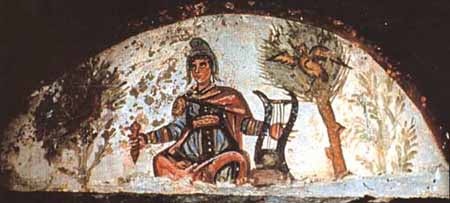
Christ as Orpheus (Christ-Orpheus Arcosolium)
Funerary Fresco, Catacomb of Saints Marcellinus and Peter, Rome — c. 4th century
Doctrinal reflection
A young man sits playing the cithara (lyre); animals gather around him peaceably, listening to the music — birds, a lamb, a horse. The composition is the classical iconographic type of Orpheus among the animals — the Greek mythological singer whose music tamed wild beasts and (in later legend) descended to Hades to retrieve his lost love. The fresco is in an arcosolium (burial niche) at the Catacomb of Saints Marcellinus and Peter in Rome, c. 4th century. The Christian reinterpretation identifies the Orpheus-figure with Christ — the singer whose music tames the wild beasts, who descended to Hades on a mission of salvation, who calls the listening creatures to him. Fresh Roman catacomb site opens. The corpus's second pre/early-Constantinian Roman entry alongside good-shepherd-priscilla (#150).
Christ-as-Orpheus — apostolic-tradition extension carefully held. The Orpheus-Christ identification was a recognized early Christian typological move (Clement of Alexandria's Protrepticus makes the explicit identification c. 200 AD: "Behold the might of the new song! It has made men out of stones, men out of beasts. Those, moreover, that were as dead, not being partakers of the true life, have come to life again, simply by becoming listeners to this song"). The early Christians read Orpheus's taming-the-beasts as iconographic prefiguration of Christ's gospel that tames the human wildness and Orpheus's descent-to-Hades as iconographic prefiguration of Christ's harrowing of hades (1 Pet 3:18–19, with the corpus's locked Anastasis-restraint applied — referenced but not adjudicated).
The corpus's three-fence rule applied to classical-pagan iconographic borrowing. Affirm: classical iconographic vocabulary borrowed and reframed Christologically is legitimate apostolic-tradition extension when the Christological content is clearly anchored. The pattern is consistent with the corpus's locked observation at #108 Paris Psalter (Melodia personification beside David), #121 Vienna Genesis (Spring personification beside Rebecca), #150 Good Shepherd (kriophoros classical type reframed as Christ). Decline: the direct identification of Orpheus as Christ in any way that would conflate pagan-mythological figure with the apostolic Lord. The early Christians used Orpheus as prefigurative-vocabulary, not as equivalent-deity. Refuse: the modern liberal reduction that turns Christ-as-Orpheus into evidence that Christianity is just one mystery cult among many. The borrowing was vocabulary-import; the doctrinal content was apostolic.
Collection 1 framework — Christ-as-Lord in pastoral-musical register. The Good Shepherd (#150) renders Christ-as-Lord in pastoral-shepherd vocabulary; the Christ-Orpheus renders Christ-as-Lord in pastoral-musical vocabulary. Both early-Christian compositions are pre-Constantinian iconographic experiments — Christians borrowing Greco-Roman visual conventions and reframing them as Christological vocabulary. The corpus's corner pre-Constantinian collection (Good Shepherd Priscilla + Christ-Orpheus Marcellinus) shows the iconographic-development process: Christians did not start with the Pantocrator iconography of later Byzantium; they started with shepherds and singers, and the iconography developed across centuries as the doctrinal-imperial-political context shifted.
The Iconographic-survival principle (#70) at the longest temporal scale. Pre-Constantinian Christian iconography survives in only a few Roman catacombs and a handful of Eastern outliers (Dura-Europos, Egyptian sites). The Catacomb of Marcellinus and Peter's preservation through 1700 years gives the corpus access to iconography painted while the apostles' first-century witnesses were still potentially living memory. The corpus reads this as the iconographic-survival principle's outer-limit case: the apostolic doctrine survived in iconography at every stage, including the experimental pre-Constantinian moment.
Orpheus's downfall and the corpus's reading. The Orpheus myth ends in failure — Orpheus loses Eurydice in his attempted descent because he turns to look at her before reaching the upper world. The early Christian iconographic borrowing intentionally selects only the positive Orpheus (the singer-among-the-animals; the descent-on-mission-of-salvation) and ignores the failed Orpheus (the broken-hearted singer, the failure to retrieve Eurydice). The corpus reads this as iconographic-discipline: the Christians borrowed the vocabulary's positive valence (singer-tames-beasts) and let the negative valence (Orpheus's failure) drop. Christ does not fail; Christ does not lose Eurydice; Christ raises Adam by the wrist (the corpus's locked Anastasis reading at #111). The iconographic-borrowing was selective and Christologically disciplined.
A young singer plays the cithara. The animals listen. The Christian community reframed the iconography to read: Christ is the singer; the gospel is the music; the wild beasts are the human heart; the music tames us into peace. Fresh Roman catacomb opens; pre-Constantinian iconographic experimentation rendered visible.