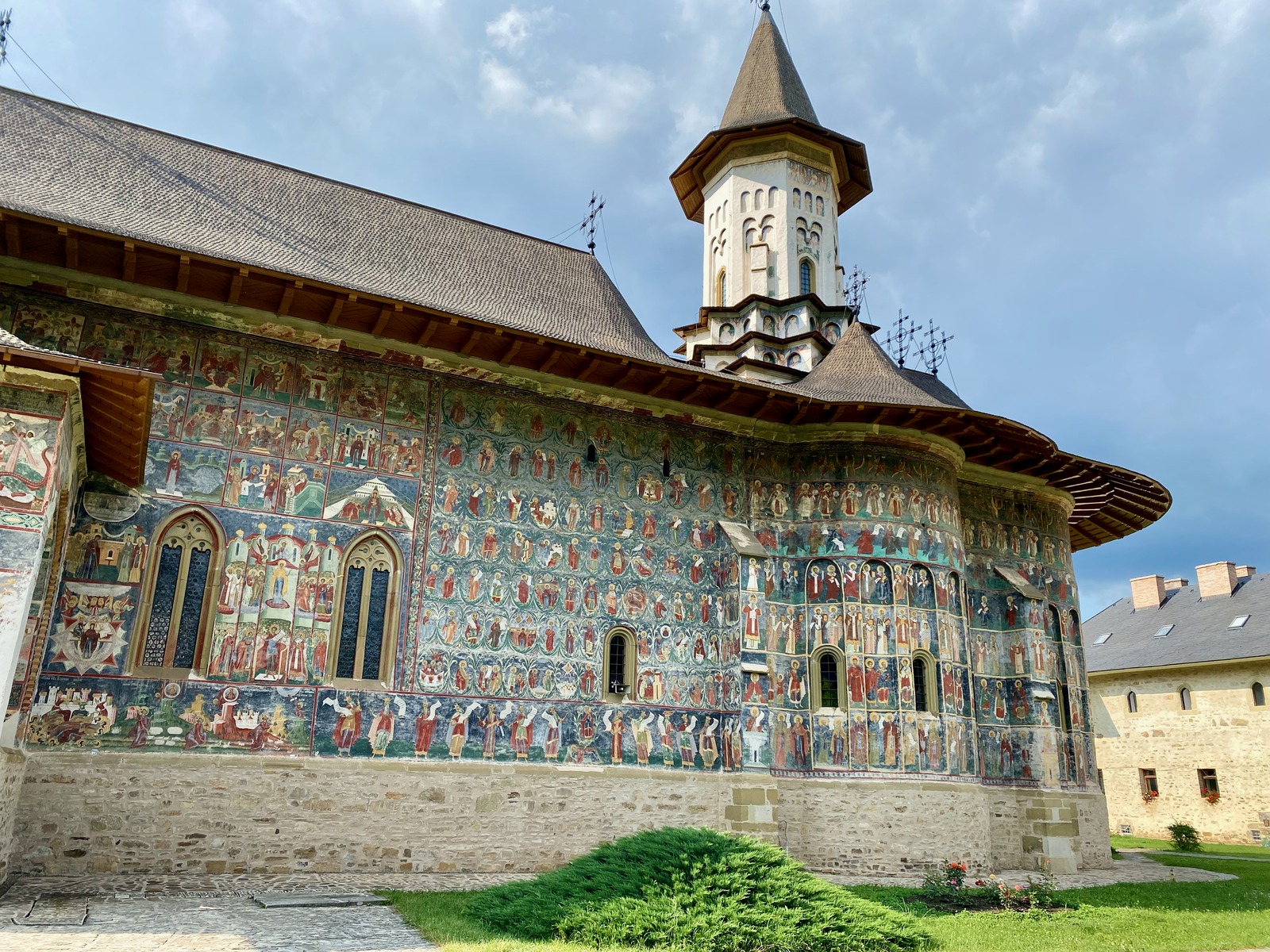
The Sucevița Fresco Program (Interior Wall View)
Painted-Monastery Frescoes, c. 1602–1604, Sucevița Monastery, Bukovina, Romania
Doctrinal reflection
Layered registers of fresco painting cover the walls — an iconographic compendium of the Christian story rendered in the dense narrative-program style typical of late Moldavian painted churches. Sucevița was the last of the great Moldavian painted-monastery programs (commissioned 1602–1604, after which the Ottoman pressure curtailed major iconographic patronage in the region). The program covers both interior and exterior surfaces; the exterior northern facade carries the famous Ladder of Virtues (the Sucevița Heavenly Ladder), the southern facade carries the Tree of Jesse with Greek philosophers, and the western facade carries the Last Judgment. The corpus's fourth Romanian entry alongside Voroneț's Last Judgment (#last-judgment-voronet) and Lion-and-Dragon (#lion-dragon-voronet). Sucevița opens as fresh Romanian site; Romania 2 sites.
Collection 3 framework anchored — eschatological exterior preaching. The corpus locked the exterior-fresco-program reading at #lion-dragon-voronet (#106): the Moldavian painted churches turn iconography outward — the exterior surfaces preach to anyone passing by. Sucevița extends the same iconographic discipline. The exterior Ladder of Virtues is a Collection 3 second-coming entry par excellence: 32 rungs of monastic-Christian virtue, monks climbing, demons trying to pull them down, Christ at the top receiving those who reach. The compositional theology: the Christian life is a climb; the climb is real; the demons are real; Christ at the top is the destination.
The Ladder of Virtues' relationship to #72 Climacus Sinai. The Sinai Ladder of Divine Ascent icon (#72) and the Sucevița Ladder of Virtues exterior fresco render the same iconographic source — John Climacus's 7th-century Ladder of Divine Ascent. The Sinai icon is c. 1150 monastic-internal devotional object; the Sucevița fresco is c. 1602 exterior public catechesis. The same iconographic vocabulary travels from monastery interior to village-facing exterior wall, from the Sinai Bedouin context to the Bukovina village context. The eye-line-as-doctrine principle (locked at #72 Climacus, where the climbers look at Christ at the top) operates at both renderings: the climbers' attention is the doctrine; the climb is real but the destination is what matters.
Tree of Jesse with Greek philosophers — the iconographic boldness. The southern wall's Tree of Jesse depicts Christ's Davidic ancestry growing from Jesse's reclining figure, but flanks the tree with ancient Greek philosophers — Thucydides, Sophocles, Plato, Aristotle, Pythagoras. The compositional argument: the Greek philosophical tradition's partial truths point forward to the fullness of revelation in Christ. The corpus reads this through Acts 17:22–34 (Paul at the Areopagus — as certain also of your own poets have said — affirming Greek poetic-philosophical insight without endorsing pagan religion) and Romans 1:19–20 (the invisible things of him from the creation of the world are clearly seen). The Moldavian iconographer's compositional move is theologically defensible: Christ is the fulfillment of all truth-pointing, including pre-Christian philosophical aspiration.
The post-Byzantine Moldavian register. Sucevița was painted under the Movilă family's patronage in 1602–1604, almost 150 years after Constantinople's fall. The Moldavian church in this period understood itself as a custodian of Byzantine iconographic tradition under Ottoman pressure; the painted-monastery exteriors are the period's distinctive iconographic strategy — make the iconography unmissable to the village population, since the political-religious context could not be assumed. The Iconographic-survival principle (#70) operates at the regional level: late-Byzantine iconography survived in northern-Romanian Moldavia precisely because the church chose the exterior-public-preaching strategy when interior-aristocratic iconography was politically constrained.
Romania broadens to 2 sites (Voronet + Sucevita). Voronet at 2 entries (Last Judgment + Lion-and-Dragon); Sucevița now opens at 1 entry; Romania at 3 total entries / 2 sites. Lock A's three-entry-gap activates after Sucevița entry — no further Sucevița additions until 3 intervening.
The walls preach. The Ladder of Virtues climbs to Christ at the top; the Tree of Jesse roots in David and flowers in Christ; the Last Judgment faces the village from the western wall. The corpus's painted-monastery tradition continues — exterior iconography preaching the gospel to whoever passes by.