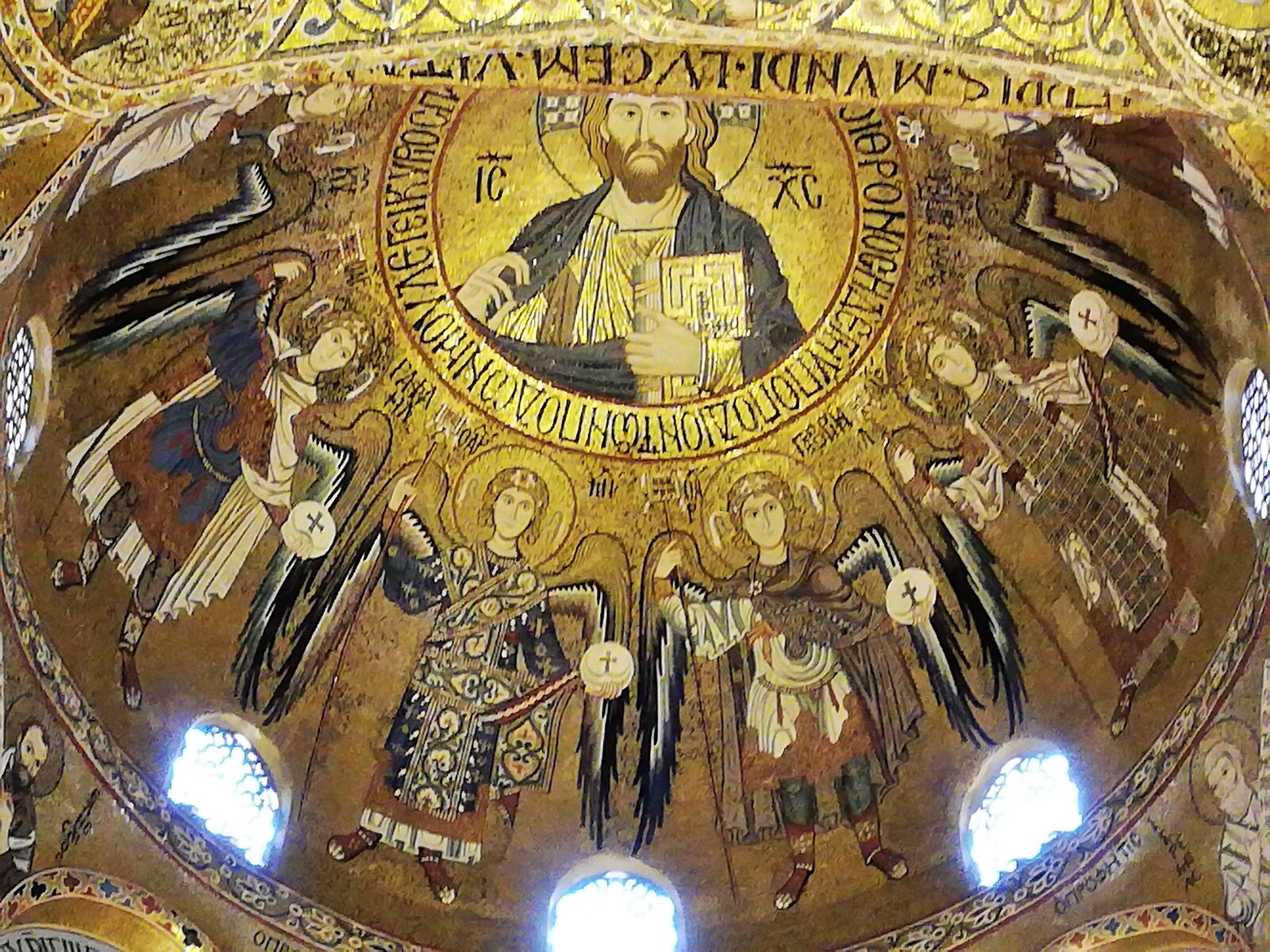
Christ Pantocrator
Cupola Mosaic, Capella Palatina
Doctrinal reflection
This is a king's chapel. And the king who built it knelt under another King.
Roger II of Sicily completed the Capella Palatina in his royal palace in Palermo by 1143. He was the strongest ruler in the western Mediterranean. In the small private chapel where he heard mass, he placed a Christ Pantocrator in the cupola, surrounded by eight angels, looking down on the spot where the king himself stood.
That is the most political mosaic in this collection. Roger II ruled men. The Christ above him ruled Roger II.
Hebrews 1:6 says, "And again, when he bringeth in the firstbegotten into the world, he saith, And let all the angels of God worship him." The eight angels in this dome are the visual rendering of that verse. They circle Christ in postures of worship — wings tilted toward him, hands extended. The angels in this dome do not look at the king. They look at Christ.
Notice what kind of place this chapel was. The walls of the Capella Palatina mix Byzantine mosaics, Latin liturgy, Greek inscriptions, and an Islamic muqarnas wooden ceiling — three civilizations meeting in one small space. Twelfth-century Sicily was the most culturally entangled court in Europe. Roger II was a king who could read Arabic. And over all of it, in the cupola, was Christ — blessing with one hand, holding the gospel in the other.
Psalm 2 answers the question this chapel quietly raises: "Why do the heathen rage, and the people imagine a vain thing? The kings of the earth set themselves... against the Lord, and against his anointed... He that sitteth in the heavens shall laugh." Roger II was wise enough to put his head under the laughter rather than be a target of it.
When you preach Christ to those who hold power, preach him as the King above kings. Every throne is an under-throne.