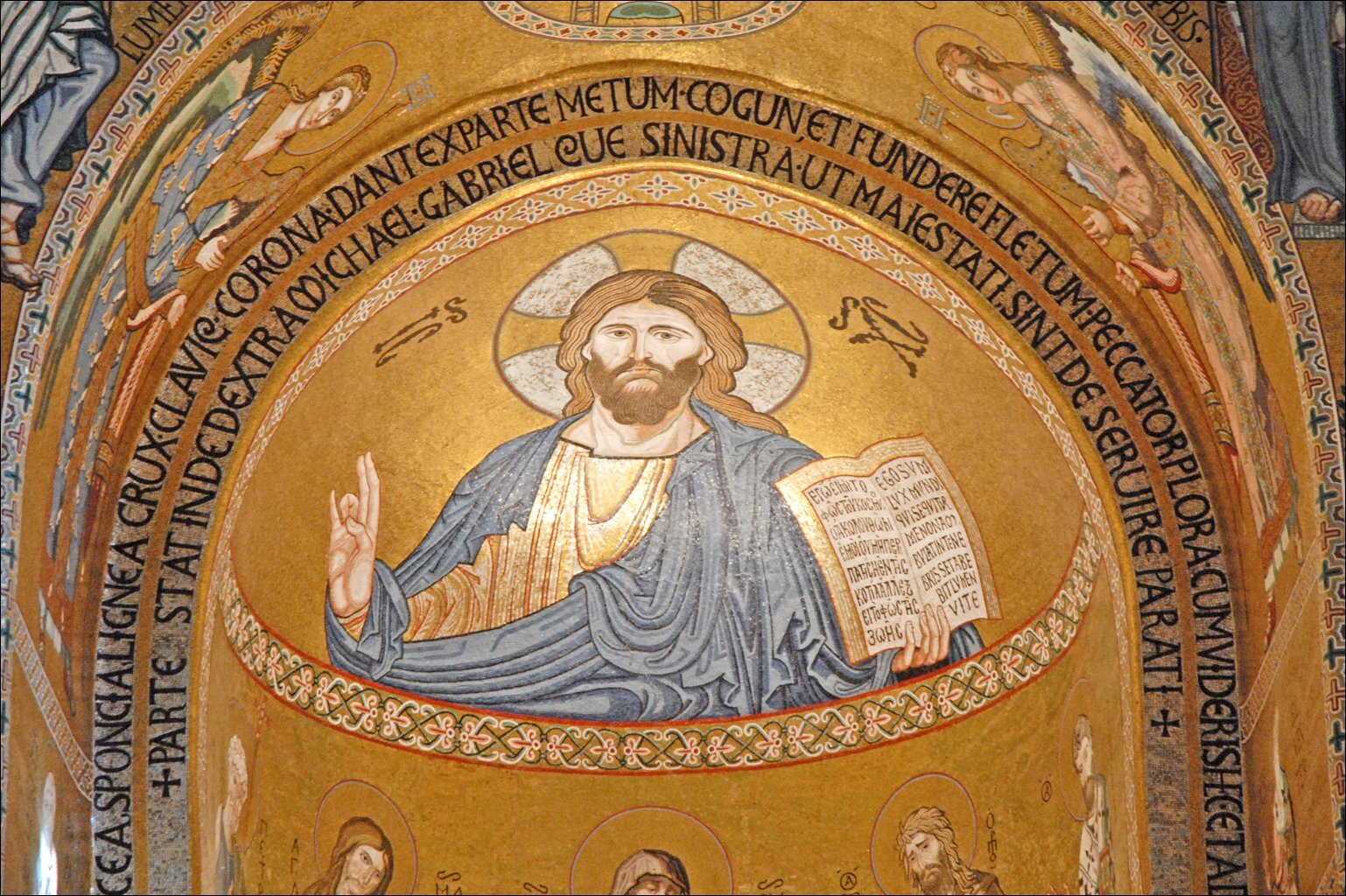
Christ Pantocrator of the Apse
Apse Mosaic, Cappella Palatina, Palermo — c. 1140–1160 (Norman Sicilian)
Doctrinal reflection
The same Christ who fills the dome of the chapel fills the apse over the altar. Same composition, different sky.
The Cappella Palatina has two Pantocrators. The cupola Pantocrator (corpus #pantocrator-capella-palatina) presides overhead from the dome — Christ as cosmic Lord, the King under whom Roger II built his royal chapel. The apse Pantocrator presides over the altar — Christ in the half-dome of the bema, hand raised in blessing, gospel-book open in the left hand, gold ground filling the curve. The Greek mosaicists who made both used the same iconographic vocabulary: frontal Christ, almond eyes, asymmetric face, beard, the blessing right hand and the held book. What changes is the architectural register. The dome Christ looks down from above; the apse Christ looks out from above the altar.
The same Christ. Different sky.
This is the Pantocrator iconography in its most architecturally precise form. The Eastern liturgical tradition placed the Pantocrator in two locations because Christ does two things in one ministry. From the dome — cosmic Lord, judge of the living and the dead, the head over all things to the church (Ephesians 1:22). From the apse — host of the eucharistic table, behold, I am with you alway, even unto the end of the world (Matt 28:20), as often as ye eat this bread, and drink this cup, ye do shew the Lord's death till he come (1 Cor 11:26). The cosmic Lord and the eucharistic host are not two Christs. The mosaicists at Palermo render the same face twice in the same chapel because the doctrine refuses the bifurcation.
The iconographic argument is enacted by placement, not by paint. The apse Pantocrator above the altar settles a specific doctrinal question by composition: the Christ who sits enthroned in cosmic glory is the same Christ who is present at the table of the church's memorial. The corpus has named this attribute-coherence at #84 Bawit — one Christ across cosmic and incarnate registers. The Cappella Palatina apse Pantocrator extends the move: one Christ across cosmic and eucharistic registers. The throne is high and lifted up; the table is in the chapel; both are the same Lord.
Hebrews 10:21–22 anchors the move: "And having an high priest over the house of God, let us draw near with a true heart in full assurance of faith." Christ is high priest (cosmic-priestly office) and with us at the table (drawing-near accessibility) in one priestly action. The apse placement renders the verse compositionally: the high priest is over the altar (the apse half-dome above) where the church draws near (the gathered communion below). Not two Christs. One Christ in two postures of his single priestly ministry.
The historical context tightens the reading. The Cappella Palatina was built by Roger II of Sicily (r. 1130–1154), a Norman Catholic king ruling a multi-confessional Sicily in the long shadow of the 1054 East-West Schism. The chapel was decorated by Greek Byzantine mosaicists (Eastern Orthodox iconographic vocabulary) for a Latin Catholic patron (Roger paid for the chapel and heard mass there) under a muqarnas wooden ceiling carved by Arab artisans (Islamic ornament fills the upper register). Three traditions in one chapel — and the apse Pantocrator above the altar is the Greek mosaicists' iconographic argument that whatever the political-ecclesiastical fragmentation around the chapel, the Christ at the altar is one Christ. The cosmic Lord and the eucharistic host are the same person, regardless of which tradition the worshipper brings to the table.
The corpus has been building this attribute-coherence reading across multiple entries — Bawit (#84) for the cosmic-and-incarnate registers; pantocrator-sinai for the Chalcedonian two-natures in the face; santi-cosma-damiano-apex-lamb (#68) for the slain-and-living Lamb at the apex. The Cappella Palatina apse Pantocrator adds the cosmic-and-eucharistic register to the same coherence. Different iconographic vehicles, same one Christ.
Look up at the dome. Look forward at the apse. The face is the same.