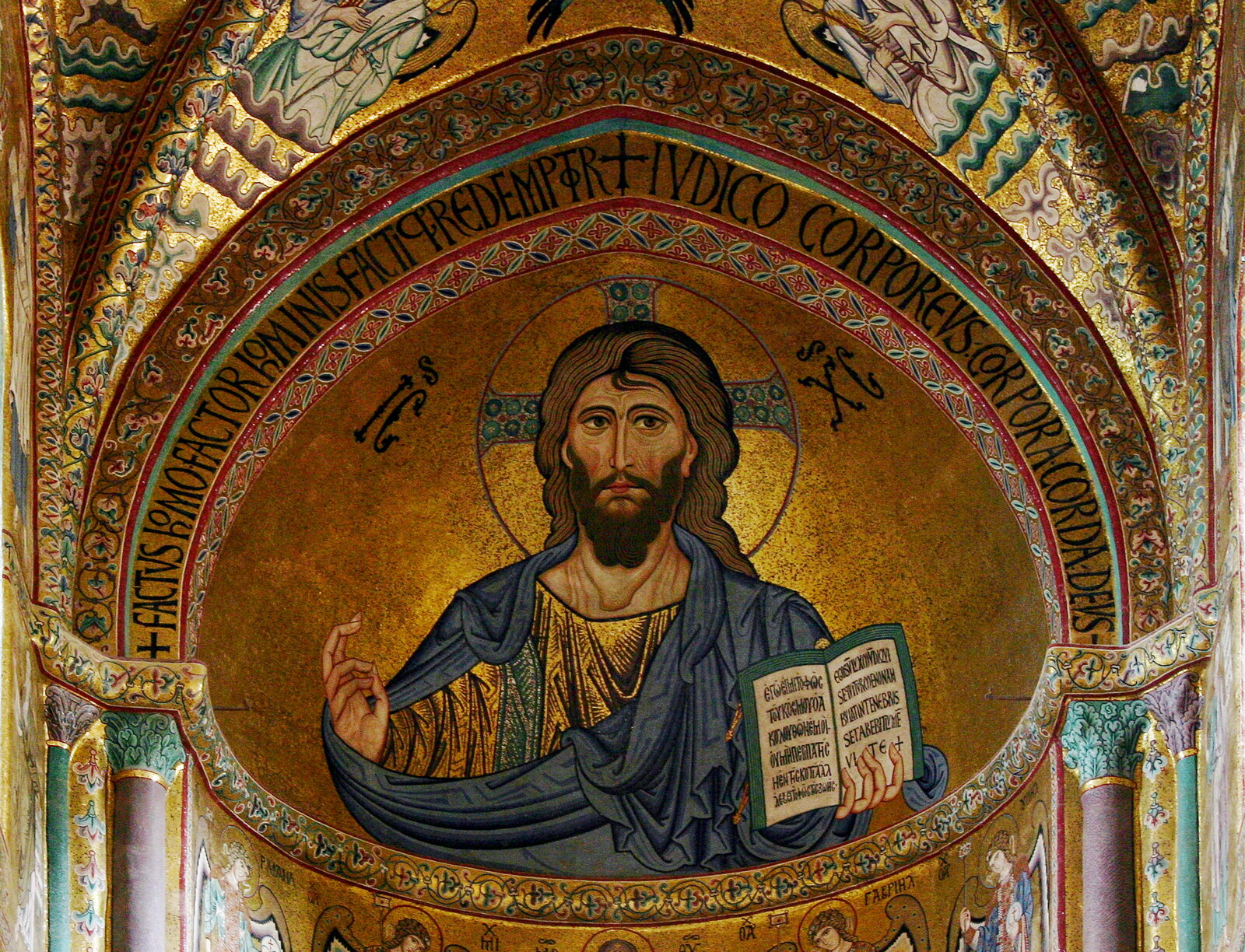
Christ Pantocrator
Apse Mosaic, Cefalù Cathedral
Doctrinal reflection
Look at what he is holding.
Most Pantocrator images show Christ with a closed gospel book — sealed authority, the book to be opened on the Last Day. Cefalù's Christ holds his book open, and what he wants you to read is this: Ego sum lux mundi. Ἐγώ εἰμι τὸ φῶς τοῦ κόσμου. "I am the light of the world."
The text is John 8:12, written twice — Greek on the left page, Latin on the right. Twelfth-century Sicily was a hinge of cultures: Norman kings on the throne, Byzantine craftsmen on the scaffolding, Greek and Latin and Arabic all spoken in the same streets. King Roger II commissioned this cathedral as his planned tomb. The bilingual gospel was not an art-historical curiosity. It was a confession: Christ is not the Lord of the East or of the West. He is Lord of both, and he speaks every tongue.
Notice that what Christ holds is his own words. He is the Word (John 1:1), and what he reveals to us is himself. This is the doctrine of self-revelation rendered in mosaic. We do not climb up to find God; God speaks, and what he speaks is his Son.
John 8:12 finishes with a promise: "he that followeth me shall not walk in darkness, but shall have the light of life." That is not metaphor for a comfortable feeling. It is direction. To follow Christ is to walk somewhere — out of one country into another, away from death and toward life. The believer who is not walking is not following.
When Cefalù's Christ looks down from the apse and shows you his open book, he is not asking you to admire it. He is asking you to read, and then to walk.