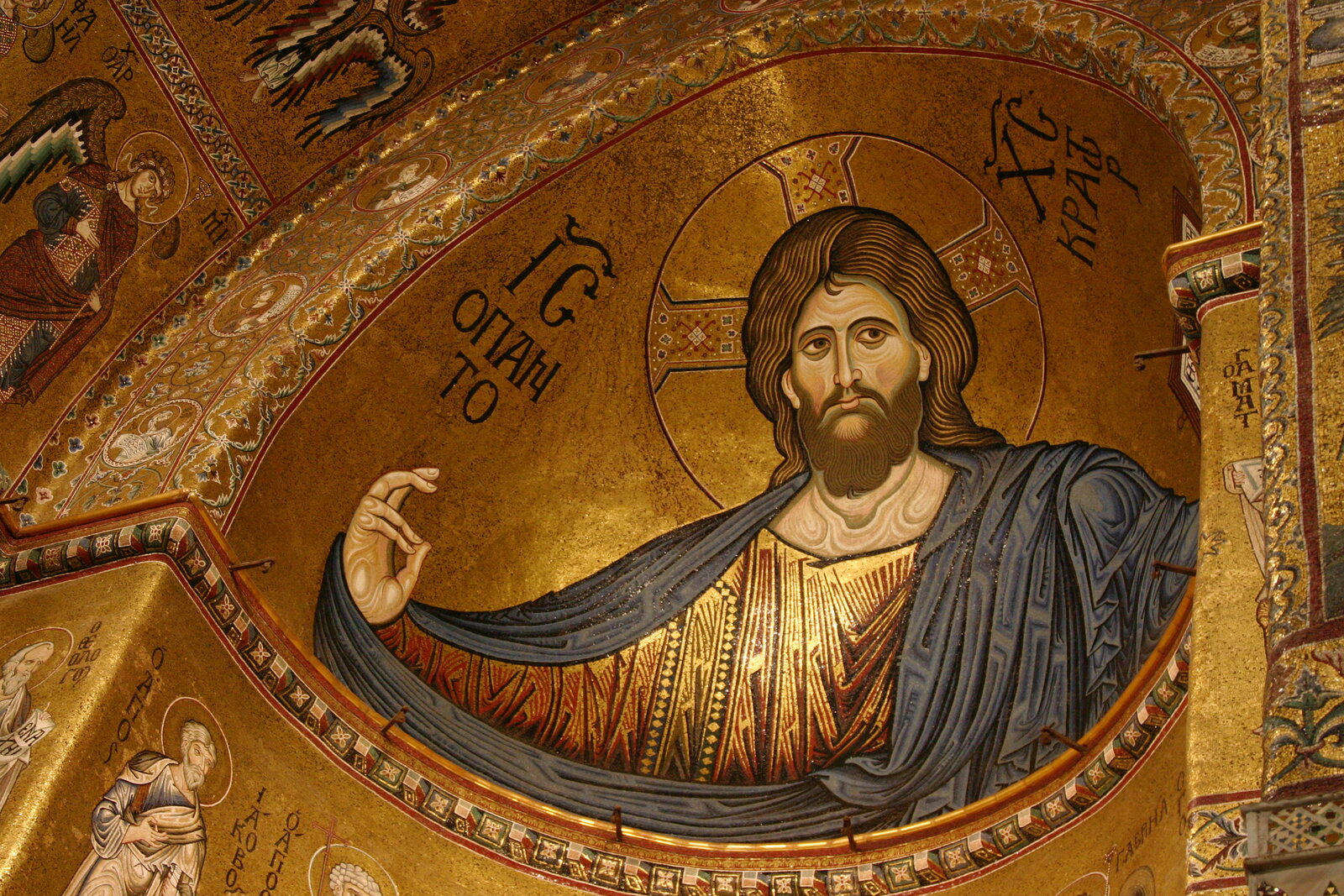
Christ Pantocrator
Apse Mosaic, Monreale Cathedral
Doctrinal reflection
Step inside the Cathedral of Monreale and you cannot take him in at one glance.
The Christ Pantocrator in the apse is the largest surviving image of Christ from the Byzantine world. He fills the entire semi-dome over the high altar. His face alone is wider than a man is tall. Whatever spot you stand on — narthex, nave, transept — your eye cannot frame him without turning your head. The Byzantine craftsmen who set this mosaic on the orders of King William II of Sicily in the 1180s made an image you have to physically yield to in order to see.
This was deliberate. Isaiah saw something like it: "I saw also the Lord sitting upon a throne, high and lifted up, and his train filled the temple" (Isaiah 6:1). The man who walks into Monreale walks into Isaiah's vision rendered in glass and gold. Christ does not fit. He overflows the architecture.
What he holds, in his open book, is a bilingual gospel — Greek on one page, Latin on the other, the same John 8:12 you have already seen at Cefalù. But here it lands differently. The huge Christ holds his small word, and the small word is enough. He does not need to shout. He simply is.
Ephesians 3:18–19 prays that the believer might "comprehend with all saints what is the breadth, and length, and depth, and height; and to know the love of Christ, which passeth knowledge." The Monreale apse is that prayer in mosaic. You cannot take him in. That is the point.
When you preach Christ, do not shrink him to the size of your sermon. The God who fills the temple will not fit the manuscript. Let him be large.