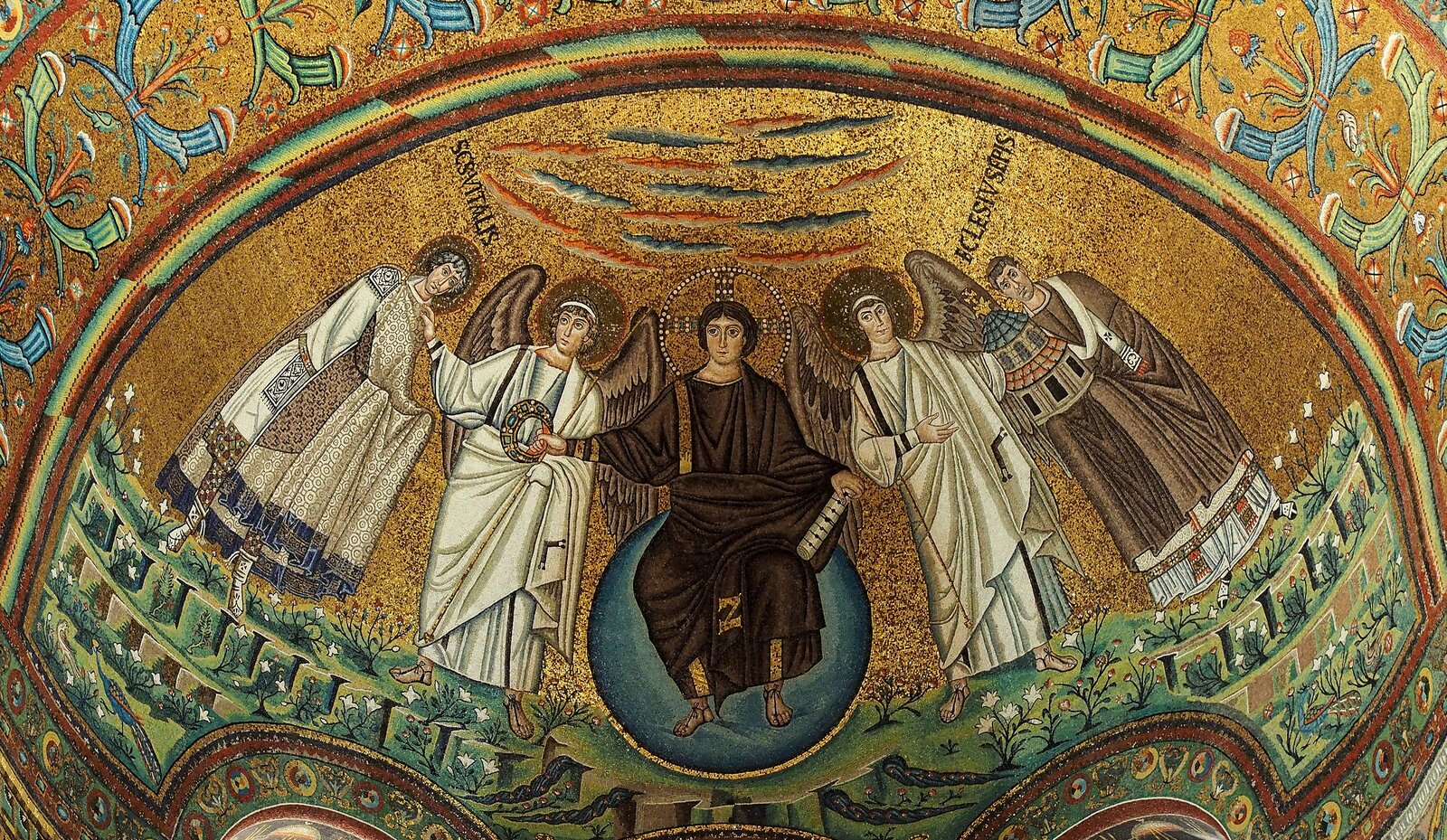
Christ Enthroned with Archangels
Apse Mosaic, San Vitale, Ravenna (c. 547)
Doctrinal reflection
The Lord on the orb, the angels at the elbows.
The apse of San Vitale at Ravenna shows the youthful, beardless Christ — early Byzantine type — seated on the cosmic globe, holding a scroll with seven seals (Revelation 5:1). At his right hand stands Saint Vitalis, the basilica's titular martyr, receiving from Christ a martyr's crown. At his left, Bishop Ecclesius, the founder, offers Christ a model of the basilica he has built. Between Christ and the two human figures, an archangel stands on either side — Michael at Christ's right, Gabriel at his left, holding tall staffs, doing court-attendance work. The archangels are not separating Christ from the saints. They are framing the encounter.
This is the iconographic correction the BRIEF needed (BRIEF Collection 3 #17 originally said "Sant'Apollinare in Classe" for this composition; that was wrong — Classe has the cosmic cross [#21], not Christ enthroned with archangels. San Vitale is the actual site). The apse was consecrated in 547 under Bishop Maximian, contemporary with the Sinai Pantocrator (#2) and the Sinai apse Transfiguration (#14).
The theological work is in the choreography. Christ on the globe; archangels at his elbows; saints at the perimeter; the worshipper standing on the floor below the apse looking up. Four levels: floor (worshipper), saints (church-historical), archangels (heavenly court), Christ (throne). The Byzantine artist staged the order of approach. The angels are between the saints and Christ — but they are not gatekeepers; they are attendants of the throne. They flank Christ; they do not stand between him and his servants. Vitalis is receiving directly from Christ. Ecclesius is offering directly to Christ. The archangels are present, but they are not mediating.
This is the iconographic version of ministering not mediating. Hebrews 1:14 again: angels are ministering spirits sent forth. They serve the throne, attend the court, carry messages, fight wars — but they do not stand between humans and the Son. Christ alone mediates (1 Timothy 2:5). The San Vitale composition stages this perfectly: the archangels are right there at Christ's elbows, but Vitalis and Ecclesius are not handing things to the angels first. They are giving and receiving directly with Christ.
The scroll in Christ's hand has seven seals. Revelation 5 records what the seals are: "Who is worthy to open the book?... And no man in heaven, nor in earth, neither under the earth, was able to open the book... And one of the elders saith unto me, Weep not: behold, the Lion of the tribe of Juda, the Root of David, hath prevailed to open the book." The Lamb opens the seals. The seals release the eschatological judgments of Revelation 6 onward. The youthful Christ at San Vitale is holding the eschaton in his hand. He is ready to break the seals.
The archangels in the apse will, when the seals are broken, be dispatched to do the work Revelation 8–9 describes: trumpets blown, judgments executed, gospel preached. They are at the ready position now, as the Byzantine artist depicts, awaiting their orders. Ministering not mediating. Standing in the presence. Sent forth.
When you preach the angels, preach this composition. Angels at the elbows of the throne, dispatched at command, attending the King who alone mediates. That is the angelic post. They will not leave it.