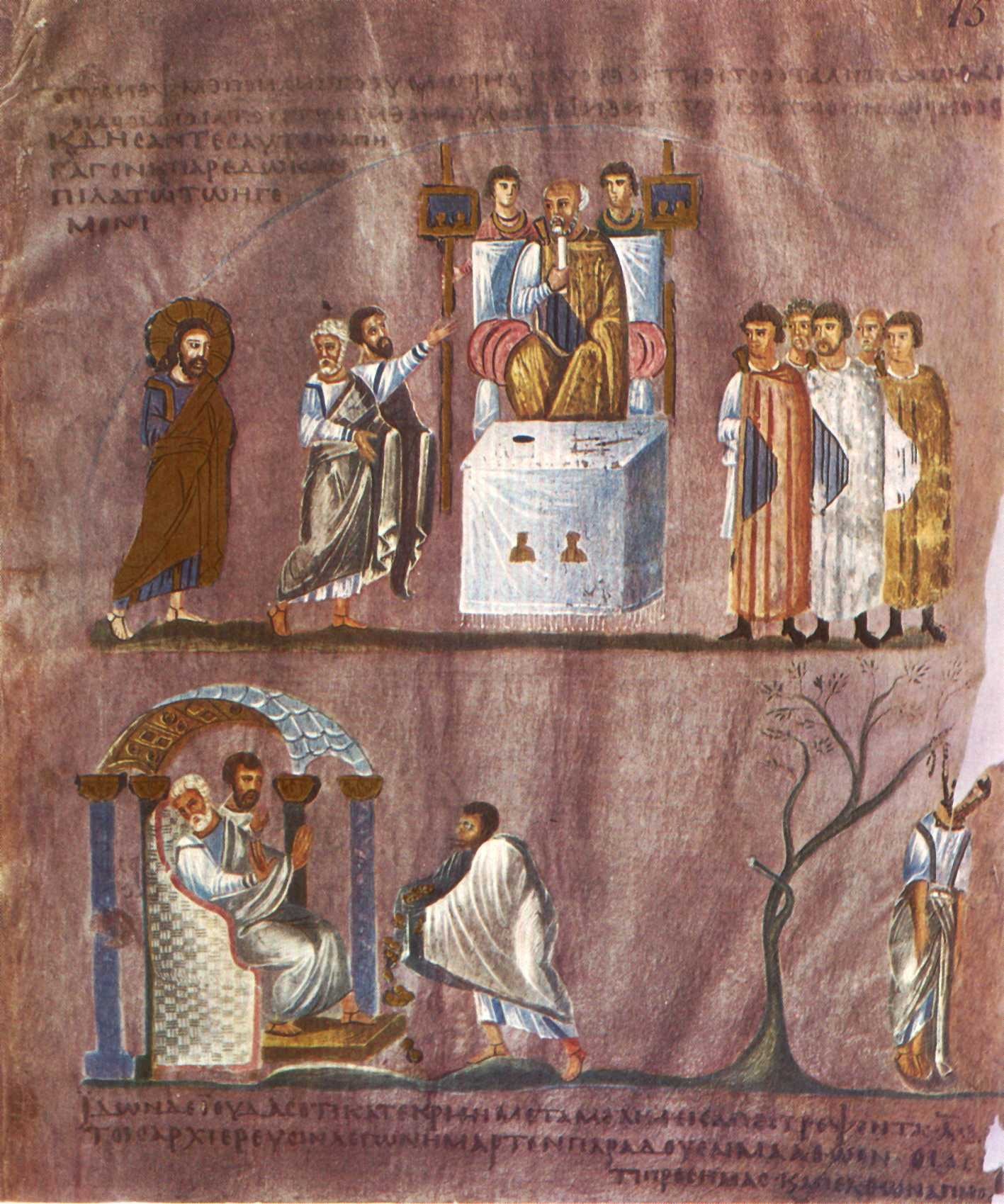
Christ before Pilate
Codex Purpureus Rossanensis, fol. 8r — c. 6th century, Syria/Antioch (Cathedral of Rossano, Calabria)
Doctrinal reflection
Two registers, vertical-narrative-strip composition. Upper register: Pilate sits enthroned in the praetorium; Christ stands bound before him; the Sanhedrin's accusers gesture vehemently from the right. Lower register: Pilate publicly washes his hands in the basin a servant holds for him ("I am innocent of the blood of this just person: see ye to it" — Matt 27:24); the crowd presses in, demanding crucifixion. Greek text in the margin identifies the trial-scene from Matthew 27. The folio is c. 550–575, Codex Purpureus Rossanensis, the corpus's third Rossano entry. Rossano manuscript closes at 3/3 ceiling.
The two registers and the political theology — Acts 4 anchored. The Rossano iconographer renders the trial in two registers because the trial has two acts: first the verbal accusation and Pilate's questioning (Matt 27:11–14, 17–18); second the formal hand-washing and crowd-judgment (Matt 27:24–26). The Christological doctrinal payload runs through Acts 4:25–28 — the apostolic exegesis of the trial as fulfillment of Psalm 2: "For of a truth against thy holy child Jesus, whom thou hast anointed, both Herod, and Pontius Pilate, with the Gentiles, and the people of Israel, were gathered together, for to do whatsoever thy hand and thy counsel determined before to be done." The political-religious authorities aligned to crucify Christ; the alignment was predetermined by God's counsel but enacted by the political-religious authorities' choice. Acts 4:25–28 holds both clauses without resolving the tension; the Rossano iconographer renders the political alignment iconographically.
Pilate's hand-washing — a specific compositional move. Matthew 27:24 records the hand-washing as Pilate's attempt to disclaim responsibility — the gesture proceeds from his judgment that the case has gone beyond his political ability to control. The Rossano lower register places the hand-washing prominently — a basin, a servant, water visibly poured. The compositional theology: the hand-washing does not actually clean Pilate's hands. Acts 2:23 names the political dimension — delivered by the determinate counsel and foreknowledge of God, ye have taken, and by wicked hands have crucified and slain. Pilate's wicked hands are the iconographic content; the basin and the water do not change the iconographic verdict.
The corpus's Collection 5 Passion register pattern-matched. The corpus has Christ before Pilate at Stavronikita (#christ-before-pilate-stavronikita) — the 1546 Theophanes the Cretan rendering. The Rossano folio is the same iconographic moment, 1000 years earlier, in different compositional register (manuscript marginalia rather than monumental fresco). The iconographic vocabulary is continuous across the millennium-gap — Pilate enthroned, Christ standing, accusers gesturing, hand-washing — locked early in the Byzantine iconographic tradition and preserved across the Latin-Greek-Slavic dispersions.
The Rossano manuscript closure at 3/3 ceiling. The corpus's three-entry Rossano program now reads as a coherent 6th-century Christological narrative trio: Healing of the Blind Man (#rossano-gospels-healing-blind-man, John 9 — Christ's saving work; I am the light of the world) + Good Samaritan (#good-samaritan-rossano, Luke 10 — Christ's neighbor-action; the Samaritan-as-Christ patristic typology) + Christ before Pilate (this entry, Matt 27 — Christ's trial; delivered by the determinate counsel). Three folios, three Christological registers, all c. 550-575 Antiochene-Syrian production. Per the manuscript-ceiling rule and the iconographic-program-coherence rule (locked after #71), Rossano closes with full doctrinal program. No further Rossano entries.
The vertical-narrative-strip compositional strategy. The Rossano iconographer uses two-register vertical compositions across the manuscript (Healing of Blind Man also two-register; Good Samaritan two-register; Christ before Pilate two-register). The compositional consistency: biblical narrative unfolds in time; iconography renders the unfolding in vertical-reading sequence. The eye-line runs top-down: viewer first sees the upper-register occasion; then sees the lower-register consequence. The strategy is consistent across the Rossano program; the consistency is itself doctrinal — the gospel is a sequence of events with consequences, not a static tableau.
Pilate sat. The accusers accused. Christ stood bound. Pilate washed his hands. The water did not clean them. Delivered by the determinate counsel and foreknowledge of God; crucified by wicked hands. The 6th-century Antiochene iconographer rendered both clauses in two registers; the Rossano manuscript closes at three folios with the apostolic-line Christological program intact.