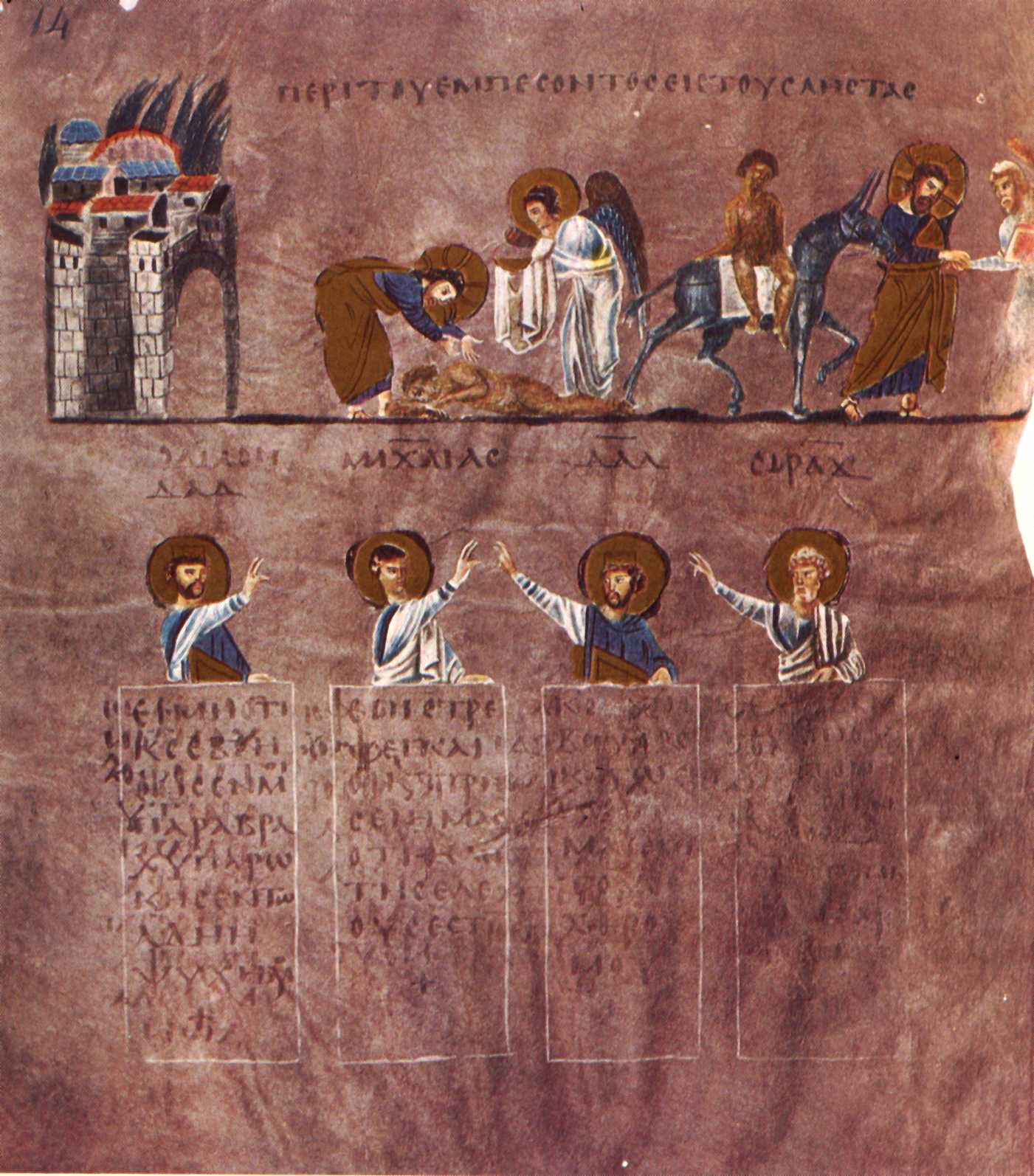
The Parable of the Good Samaritan
Codex Purpureus Rossanensis, fol. 7v — c. 6th century, Syria/Antioch (Cathedral of Rossano, Calabria)
Doctrinal reflection
The folio is in two registers, reading top-to-bottom. Upper register: a man lies wounded on the road; a priest passes by; a Levite passes by; both walk away. Lower register: the Samaritan (rendered in early-Christian iconography as a young Christ-figure with cross-halo) bends over the wounded man, pours oil and wine on his wounds, places him on a beast, brings him to the inn. Greek text in the margin identifies the parable from Luke 10:25–37. The folio is one of the few illustrated 6th-century parable-renderings to survive; it is c. 550–575, on purple-dyed parchment with silver ink. The Codex Purpureus Rossanensis is at the Cathedral of Rossano in Calabria, Italy. The corpus's second Rossano entry alongside the Healing of the Blind Man (#rossano-gospels-healing-blind-man). Rossano manuscript at 2/3.
The Christological reading of the Good Samaritan — Mode 4 patristic-tradition extension. Patristic exegesis (Origen, Augustine, Bede) read the parable as Christological allegory: the wounded man = humanity fallen in sin; the priest and Levite = the Mosaic Law unable to save; the Samaritan = Christ; the oil and wine = the sacraments / the Spirit's healing; the inn = the church; the innkeeper = the apostolic leadership; the coming again (Luke 10:35 — when I come again, I will repay thee) = the parousia. The Rossano iconographer renders the parable with the Samaritan as Christ-figure (cross-halo) — the iconographic confirmation of the patristic reading.
The corpus's three-fence application. The Christological allegorization of the Good Samaritan goes beyond the parable's primary teaching (Luke 10:36–37 — which now of these three, thinkest thou, was neighbour... Go, and do thou likewise). Luke's primary application is be-the-neighbor ethics, not Christological allegory. The corpus's discipline: affirm the patristic-tradition Christological reading as a legitimate apostolic-tradition extension (Christ IS the one who acts toward humanity as the Samaritan acted toward the wounded man — that gospel-trajectory is real); decline the systematizing-allegory that turns every detail (oil = baptism, wine = communion, two pence = OT and NT, etc.) into rigid sacramental coding; refuse the modern-liberal reduction that turns the parable into pure social-ethics with no Christological referent. The Rossano iconographer's compositional choice — the Samaritan as Christ-figure — supports the affirmation; the corpus reads what's affirmed without forcing the systematizing.
The two-register narrative compositional strategy. The Rossano folio uses vertical-narrative-strip composition: upper register = the failure (priest and Levite walk by); lower register = the resolution (Samaritan/Christ acts). The compositional theology: the gospel is the resolution to a real human problem. The eye-line runs top-down: viewer first sees the failure, then sees the action. The corpus has named the continuous-narrative-compositional-strategy at #97 Vienna Genesis and #121 Rebecca-at-the-well; the Rossano two-register strategy is its vertical variant. Biblical narrative is sequential; iconography renders the sequence; the doctrine emerges from the unfolding.
The Rossano manuscript's late-antique character. The Codex Purpureus Rossanensis was probably produced in Syria or Antioch in the mid-6th century — pre-iconoclasm Eastern iconography preserved through the manuscript's transit to southern Italy (likely brought during the Byzantine reconquest of Italy, or later through Greek-monastic networks in Calabria). The manuscript shares purple-parchment-with-silver-ink luxury characteristics with the Vienna Genesis (#97, #121) — the two manuscripts together represent the high-luxury early-Byzantine manuscript tradition. The Iconographic-survival principle (#70) operates: Syrian-origin iconography survived in Italian-Greek custody through 1500 years.
The parable's apostolic-tradition standing. Luke's Gospel is the only canonical source for the Good Samaritan parable (Luke 10:25–37 — which now of these three, thinkest thou, was neighbour unto him that fell among the thieves?). The corpus reads Luke's parable as authoritative Christological-ethical teaching: Christ told the parable to a lawyer asking who is my neighbor?; Christ's answer reframes the question — which became neighbor?; the actor-toward-suffering becomes the iconic neighbor. The Rossano iconographer's Christ-Samaritan visualizes both the Christological dimension (Christ acts toward humanity) and the ethical dimension (the church goes and does likewise).
The priest passed. The Levite passed. The Samaritan stopped. The Samaritan was Christ. The wounded man was lifted. The inn received him. The innkeeper was paid; the innkeeper was promised return-payment when the Samaritan returns. Go, and do thou likewise — both the imitative and the eschatological registers operate.