Byzantine Art Project
150 artworks from the great traditions of Byzantine and Eastern Christian iconography, each paired with a doctrinal reflection. The corpus surfaces GLM's confessional shape case by case as the iconography requires it — read what the picture argues.
150
ARTWORKS
10
COLLECTIONS
17
FLAGSHIPS
1,250+
YEARS
COLLECTION:
ERA:
REGION:
MEDIUM:
SITE / MUSEUM:
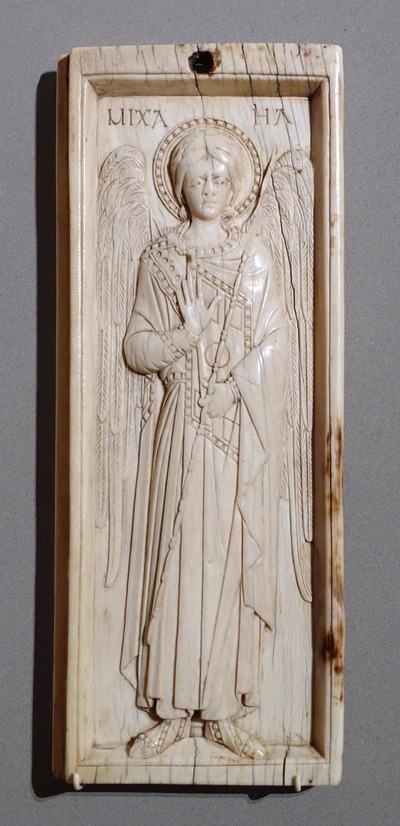 Angels
Archangel Michael Relief Panel
Photograph by Daderot (2014). Wikimedia Commons. Released under Creative Commons CC0 1.0 Universal Public Domain Dedication. The underlying 11th-century Byzantine ivory relief at the Bode-Museum is in the public domain.
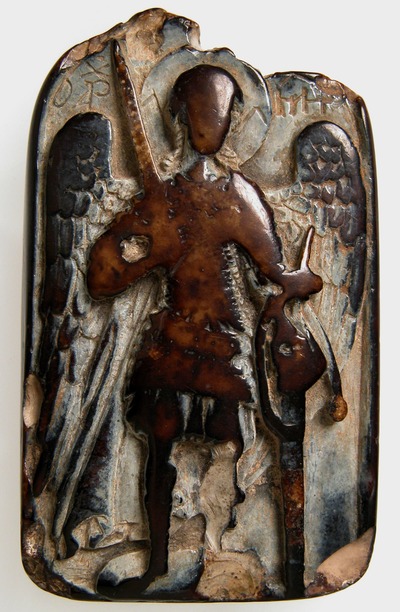 Angels
Two-Sided Pendant with the Archangel Michael and Daniel in the Lions' Den
Photograph: The Metropolitan Museum of Art, New York. Open Access (Public Domain / CC0). The underlying c. 1200+ serpentine pendant is in the public domain. Credit line: Gift of Mrs. Hayford Peirce, 1987.
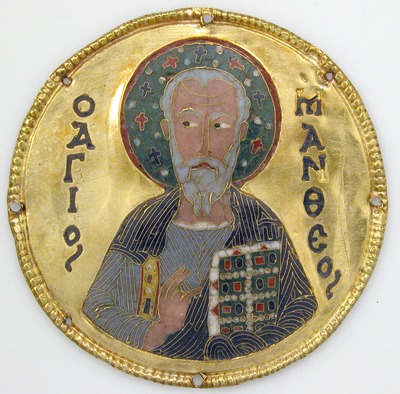 Apostles
Medallion with Saint Matthew from an Icon Frame
Photograph: The Metropolitan Museum of Art, New York. Open Access (Public Domain / CC0). The underlying c. 1100 Byzantine cloisonné medallion is in the public domain. Credit line: Fletcher Fund, 1917.
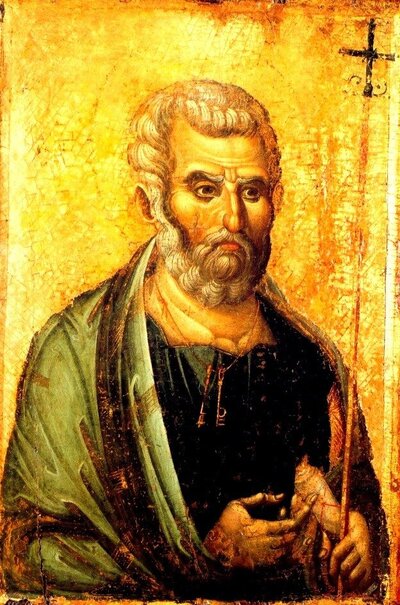 Apostles
The Apostle Peter
Photographic reproduction in the public domain (Wikimedia Commons; faithful reproduction of a two-dimensional public domain work). The underlying 13th-century Byzantine icon (93 × 61.3 cm; Dumbarton Oaks Museum, Washington D.C.) is in the public domain.
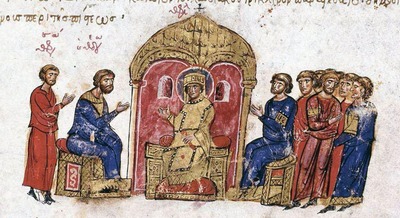 Iconoclasm Debate
The Argument about Icons (Empress Theodora and the Iconoclasts)
Public domain photographic reproduction (Wikimedia Commons; faithful reproduction of a 12th-century manuscript published before 1931). The underlying Madrid Skylitzes (Biblioteca Nacional de España, MS Vitr. 26-2) is in the public domain.
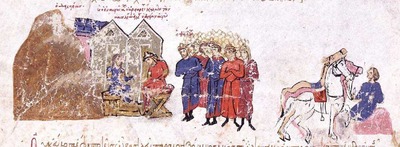 Iconoclasm Debate
Emperor Leo V and the Monk of Dagisteas
Public domain photographic reproduction (Wikimedia Commons; faithful reproduction of a 12th-century manuscript published before 1931). The underlying Madrid Skylitzes is in the public domain.
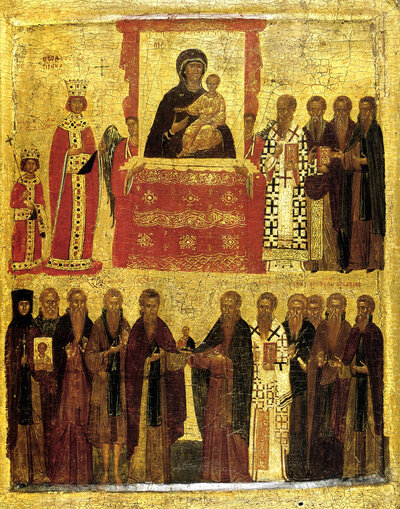 Iconoclasm Debate
The Triumph of Orthodoxy
Photographic reproduction in the public domain (Wikimedia Commons; faithful reproduction of a two-dimensional public domain work). Underlying late-14th-century / early-15th-century icon (37.8 × 31.4 cm; British Museum, 1988,0411.1) is in the public domain.
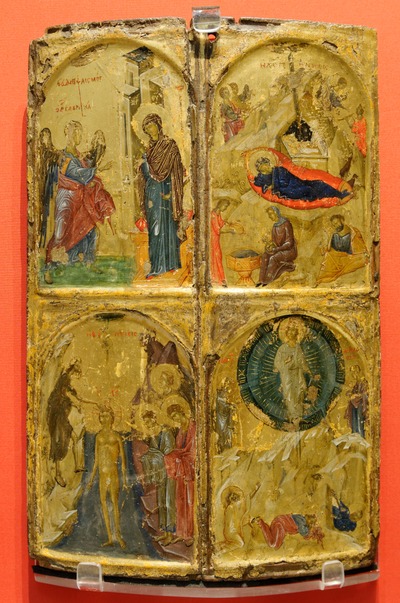 Life of Christ
Four-Festival Icon (Annunciation, Nativity, Baptism, Transfiguration)
Photograph released under Creative Commons Attribution 2.5 Generic. The underlying c. 1310–1320 Byzantine icon at the British Museum (BM 1852.1-02.1) is in the public domain.
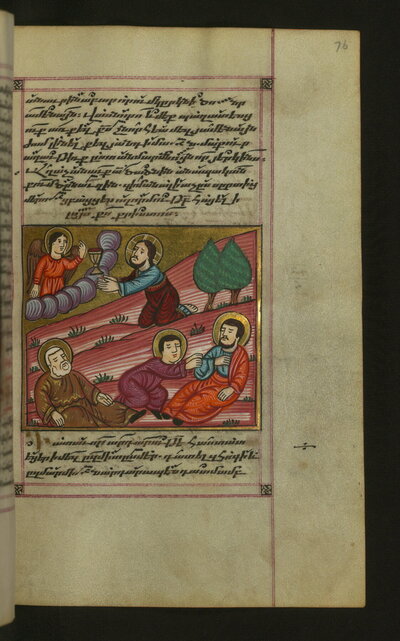 Life of Christ
The Agony in the Garden
Photographic reproduction in the public domain (Wikimedia Commons; Walters Art Museum). Released under Creative Commons CC0 1.0 Universal Public Domain Dedication. The underlying 1678 Armenian hymnal page is in the public domain.
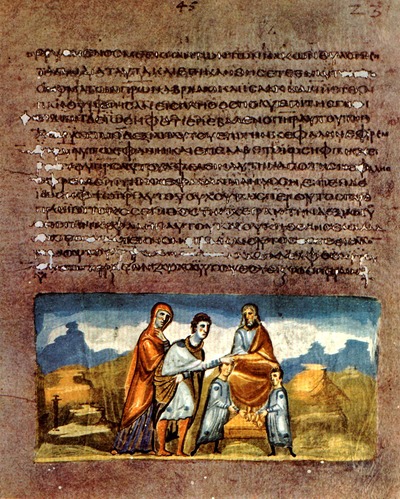 OT Typology
Jacob Blessing Ephraim and Manasseh
Photographic reproduction in the public domain (Wikimedia Commons; faithful reproduction of a 6th-century manuscript folio). The underlying Vienna Genesis is in the public domain.
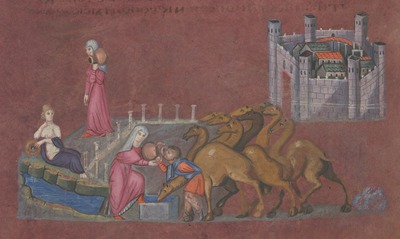 OT Typology
Rebecca at the Well
Photographic reproduction in the public domain (Wikimedia Commons; from the Yorck Project's *10,000 Masterworks of Painting*; faithful reproduction of a 6th-century manuscript folio). The underlying Vienna Genesis (Codex Vindobonensis Theol. gr. 31) is in the public domain.
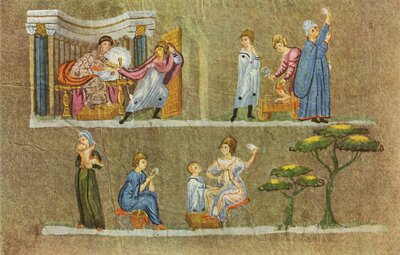 OT Typology
Joseph and Potiphar's Wife
Photographic reproduction in the public domain (Wikimedia Commons; The Yorck Project). The underlying late-6th-century manuscript page (Austrian National Library) is in the public domain.
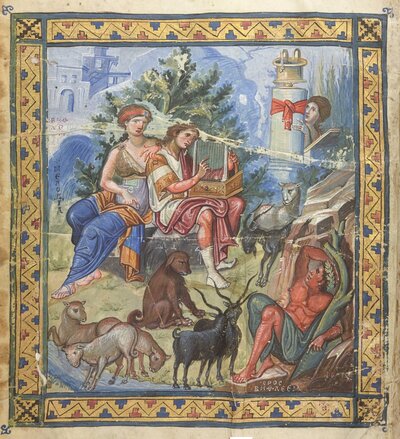 OT Typology
David Composing the Psalms
Photographic reproduction in the public domain (Wikimedia Commons; faithful reproduction of a 10th-century manuscript). The underlying Paris Psalter (BnF MS gr. 139) is in the public domain.
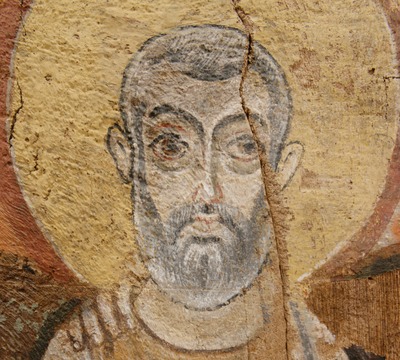 Saints
Christ and Saint Menas (the Bawit Icon)
Photograph: Musée du Louvre, Paris (Acc. E 11565). Wikimedia Commons. The underlying c. 6th–8th-century Coptic panel icon is in the public domain. Photographic reproduction in the public domain (CC0 / structured-data convention).
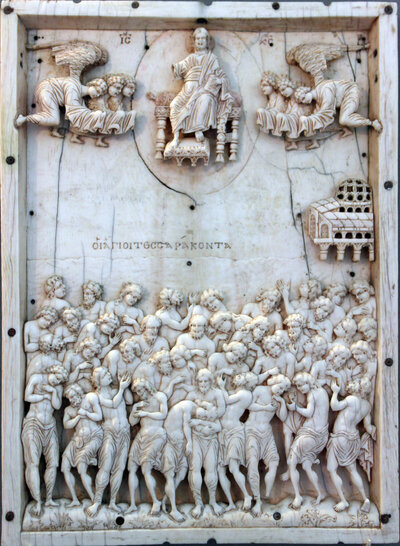 Saints
The Forty Martyrs of Sebaste
Photo by Anagoria (2013). Wikimedia Commons. Dual-licensed under GFDL 1.2+ and CC BY 3.0. The underlying 10th-century ivory plaque is in the public domain.
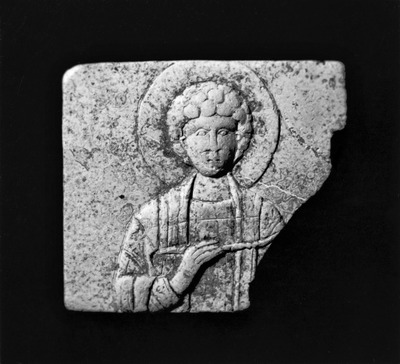 Saints
Saint Panteleimon
Walters Art Museum, Baltimore (Acc. 41.227). Released under Creative Commons Attribution-ShareAlike 3.0 (CC BY-SA 3.0) per the Walters' 2012 mass-release. The underlying 11th-century steatite is in the public domain.
 Saints
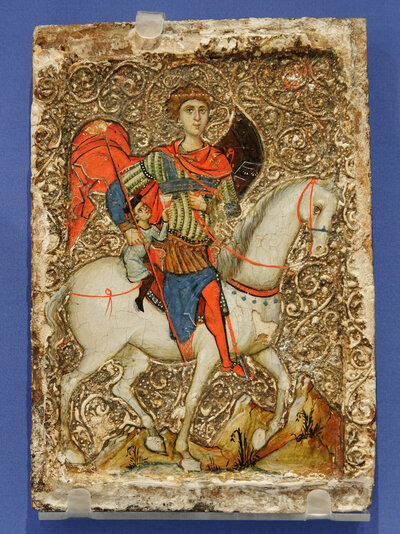
Saint George
Photo by Marie-Lan Nguyen (2012). Wikimedia Commons. Released under Creative Commons Attribution 2.5 Generic (CC BY 2.5). The underlying 13th-century icon is in the public domain. Held by the British Museum, London (accession 1984.0601.1).
 Second Coming
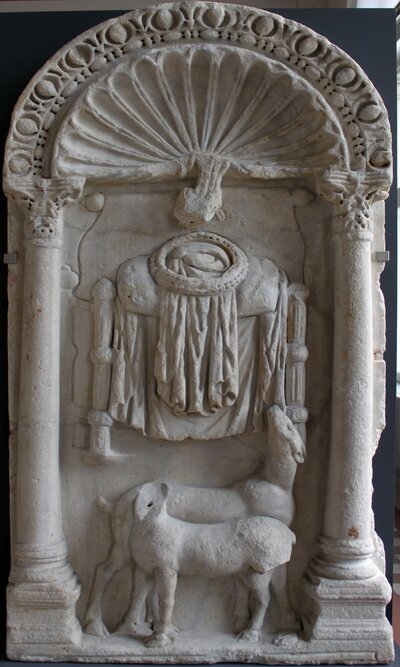
The Hetoimasia
Photograph by Anagoria (2013). Wikimedia Commons. Released under Creative Commons Attribution 3.0 Unported (CC BY 3.0). The underlying c. 400 Byzantine marble relief is in the public domain.
 Theotokos
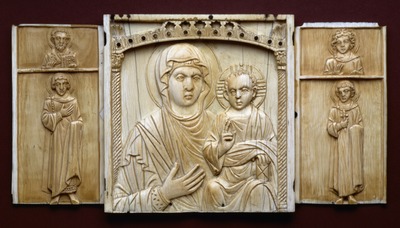
Triptych Icon of the Virgin and Child with Saints
Walters Art Museum, Baltimore (Acc. 71.158). Released under Creative Commons Attribution-ShareAlike 3.0 (CC BY-SA 3.0) per the Walters' 2012 mass-release of collection imagery to Wikimedia Commons. The underlying 10th-century ivory is in the public domain.
 Theotokos
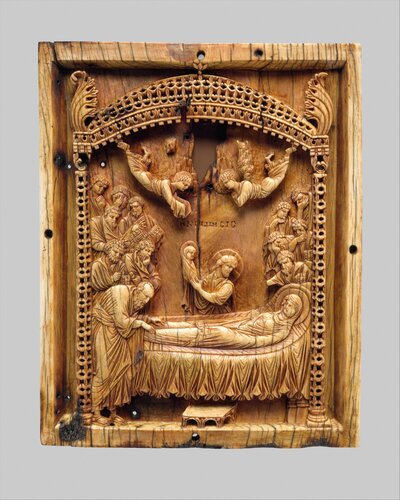
The Dormition of the Theotokos
Photographic reproduction in the public domain (Wikimedia Commons; Metropolitan Museum of Art Open Access). Released under Creative Commons CC0 1.0 Universal Public Domain Dedication. The underlying late-10th-century Byzantine ivory plaque (18.6 × 14.8 cm) is in the public domain.